Question
Convert the following frequency distribution to exclusive form :
Class-intervalFrequency
30 - 347
35 - 399
40 - 4413
45 - 496
50 - 543
55 - 5910
Use this table to find :
(i) The true class-limits of the fourth class-interval
(ii) The class-boundaries of the fifth class-interval
(iii) The class-mark of the third class-interval
(iv) The class-size of the sixth class-interval.
Answer

Class-intervalFrequency
29.5 - 34.57
34.5 - 39.59
39.5 - 44.513
44.5 - 49.56
49.5 - 54.53
54.5 - 59.510
(i) 44.5 - 49.5 (ii) 49.5 - 54.5
(iii) 42 (iv) 5

Need a full question paper?

Generate a complete, print-ready paper with questions like this in minutes — across 16+ boards, with answer keys.

Start Generating Free

Similar questions

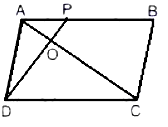
The given figure shows a parallelogram $\text{ABCD}$ with area $324 sq. \ cm. P$ is a point in $AB$ such that $AP: PB = 1:2$ Find The area of $\triangle APD.$
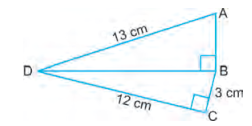
In the given figure, ABCD is a quadrilateral in which $BC =3 cm$, $AD =13 cm, DC =12 cm$ and $\angle ABD =$ $\angle BCD =90$. Calculate the length of AB .
Image
Find the perimeter of an equilateral triangle whose area is $16 \sqrt{3} \ cm$.
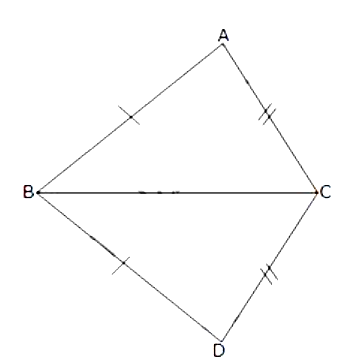
In the given figure, $A B=D B$ and $A C=D C$.

If  $\angle \mathrm{ABD}=58^{\circ}, \angle \mathrm{DBC}=(2 \mathrm{x}-4)^{\circ}, \angle \mathrm{ACB}=\mathrm{y}+15^{\circ} $ and $\angle \mathrm{DCB}=63^{\circ};$ find the values of $x$ and $y.$
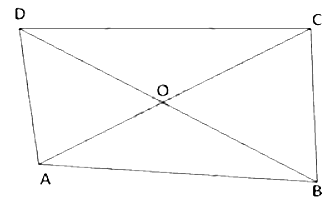
$\text{ABCD}$ is a quadrilateral in which the diagonals $AC$ and $BD$ intersect at $O$. Prove that $AB + BC + CD + AD < 2(AC + BC).$
Prove that the straight lines joining the mid$-$points of the opposite sides of a quadrilateral bisect each other.
A wire bent in the form of an equilateral triangle has an area of $121 \sqrt{3} \ cm ^2$. If the same wire is bent into the form of a circle, find the area enclosed by the wire.
The length of the common chord of two intersecting circles is $30 \ cm.$ If the diameters of these two circles are $50 \ cm$ and $34 \ cm,$ calculate the distance between their centers.
If $\log 16 = a, \log 9 = b$ and $\log 5 = c,$ evaluate the following in terms of $a, b, c: \log 12$
Two articles $A$ and $B$ are sold for $Rs. 1,167$ making $5\%$ profit on $A$ and$ 7\%$ profiton $A$ and $7\%$ profit on $B$. IF the two articles are sold for $Rs. 1,165,$ a profit of $7\%$ is made on $A$ and a profit of $5\%$ is made on $B$. Find the cost prices of each article.