MCQ
Cooling rate of a sphere of $600\,K$ at external environment $(200\,K)$ is $R$ . When the temperature of sphere is reduced to $400\,K$ then cooling rate of the sphere becomes
  • $\frac{3}{{16}}\,R$
  • B
    $\frac{16}{{3}}\,R$
  • C
    $\frac{9}{{27}}\,R$
  • D
    None

Answer

Correct option: A.
$\frac{3}{{16}}\,R$
a
$\mathrm{R}_{1} \propto(600)^{4}-(200)^{4}$

$\mathrm{R}_{2} \propto(400)^{4}-(200)^{4}$

$\frac{\mathrm{R}_{2}}{\mathrm{R}_{1}}=\frac{(16+4)(16-4)}{(36+4)(36-4)}=\frac{20 \times 12}{40 \times 32}$

$\mathrm{R}_{2}=\frac{3}{16} \mathrm{R}$

Need a full question paper?

Generate a complete, print-ready paper with questions like this in minutes — across 16+ boards, with answer keys.

Start Generating Free

Similar questions

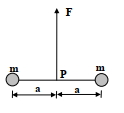
Two particle of mass $m$ each are tied at the ends of a light string of length $2 \mathrm{a}$. The whole system is kept on a frictionless horizontal surface with the string held tight so that each mass is at a distance $'a'$ from the center $\mathrm{P}$ (as shown in the figure). Now, the mid-point of the string is pulled vertically upwards with a small but constant force $F$. As a result, the particles move towards each other on the surface. The magnitude of acceleration, when the separation between them becomes $2 \mathrm{x}$ is
Stress to strain ratio is equivalent to
The force required to row a boat at constant velocity is proportional to square of its speed. If a speed of $v$ $km / h$ requires $4 \,kW$, how much power does a speed of $2 v\; km / h$ require is ........... $kW$
Which of the following graphs correctly represents the relation between ln $E$ and ln $T$ where $E$ is the amount of radiation emitted per unit time from unit area of a body and $T$ is the absolute temperature
Consider a spherical body, one third of its volume is filled with a liquid which has contact angle zero with the surface of sphere. If this sphere (along with liquid) is taken to gravity free space then shape of liquid inside sphere will look like
A vessel contains $14\,g$ of nitrogen gas at a temperature of $27^{\circ}\,C$. The amount of heat to be transferred to the gap to double the r.m.s. speed of its molecules will be $......J$ $\left(\right.$ Take $R =8.32\,J\,mol ^{-1} k ^{-1}$ )
One mole of a monatomic ideal gas undergoes an adiabatic expansion in which its volume becomes eight times its initial value. If the initial temperature of the gas is $100 K$ and the universal gas constant $R =8.0 Jmol ^{-1} K ^{-1}$, the decrease in its internal energy, in Joule, is. . . . .
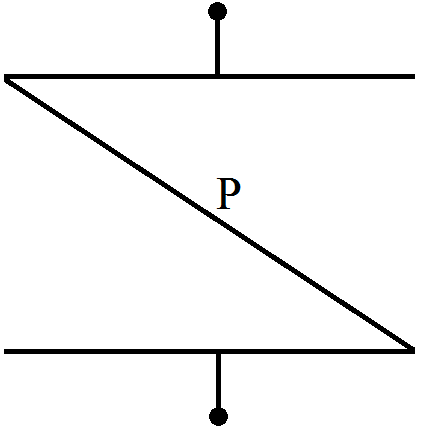
A thin metal plate P is inserted between the plates of a parallel-plate capacitor of capacitance C in such a way that its edges touch the two plates (figure). The capacitance now becomes:
A transverse wave is represented by $y=2 \sin$ $(\omega t - kx ) cm$. The value of wavelength (in $cm$ ) for which the wave velocity becomes equal to the maximum particle velocity, will be.
A bakelite beaker has volume capacity of $500\, cc$ at $30^{\circ} C$. When it is partially filled with $V _{ m }$ volume (at $30^{\circ}$ ) of mercury, it is found that the unfilled volume of the beaker remains constant as temperature is varied. If $\gamma_{\text {(beaker) }}=6 \times 10^{-6}{ }^{\circ} C ^{-1}$ and $\gamma_{(\text {mercury })}=1.5 \times 10^{-4}{ }^{\circ} C ^{-1},$ where $\gamma$ is the coefficient of volume expansion, then $V _{ m }($in $cc )$ is close to