Question
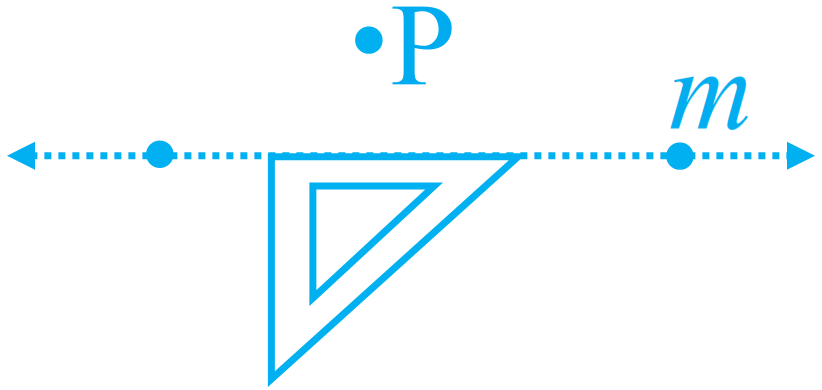
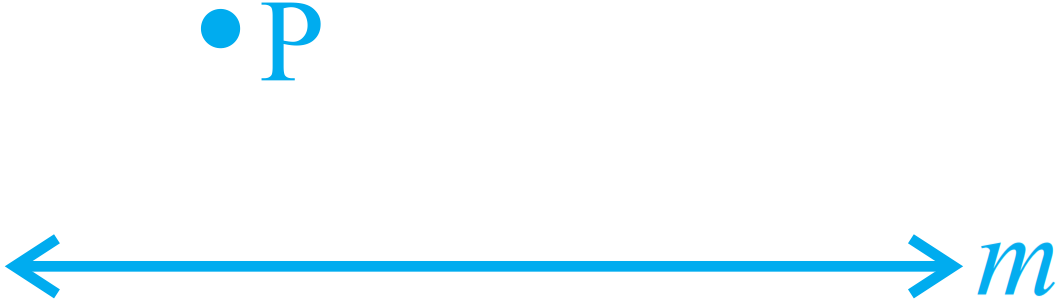
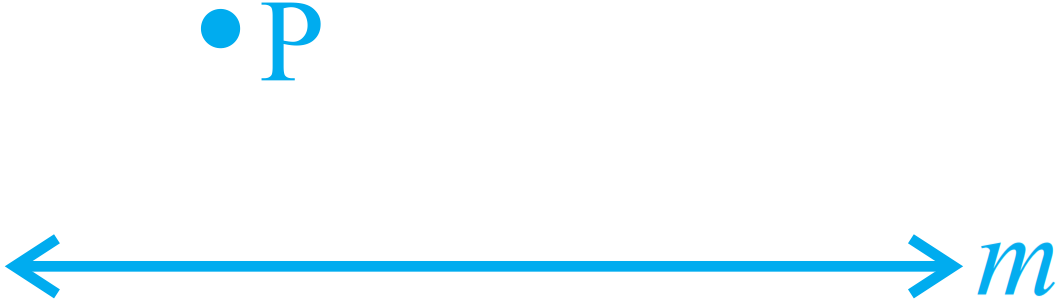
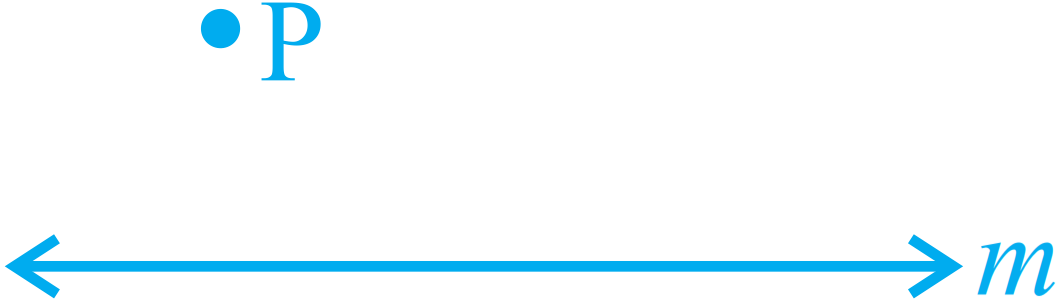
Copy Figure on your notebook and draw a perpendicular from $P$ to line m, using $(i)$ set squares $(ii)$ Protractor $(iii)$ ruler and compasses. How many such perpendiculars are you able to draw?
Answer

 
We draw perpendicular to $m$ from $P,$ using
$i.\ $Set Squares:
Step $I:$ Let $m$ be the given line and $P$ be a point outside $m.$ Now, extend line $m$ on both the sides.

Step $II:$ Place a set square on $m,$ such that one arm of its right angle aligns along $m.$

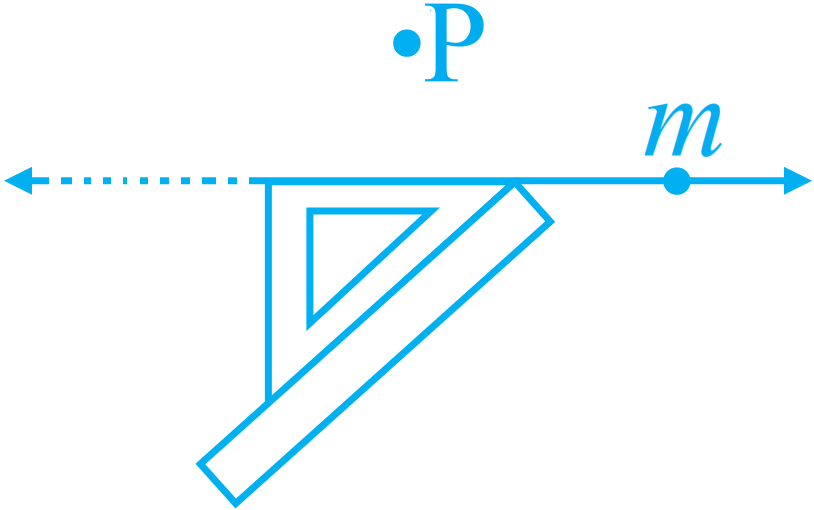
Step $III:$ Place a ruler along the edge opposite to the right angle of the set square.

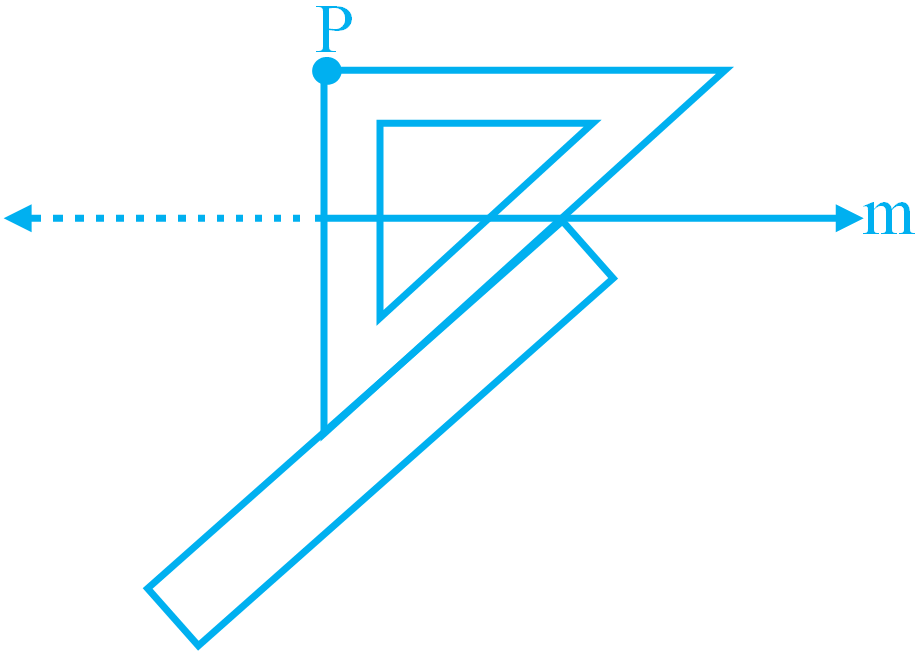
Step $IV:$ Hold the ruler fixed. Slide the set square along the ruler till the point $P$ touches the other arm of the set square.

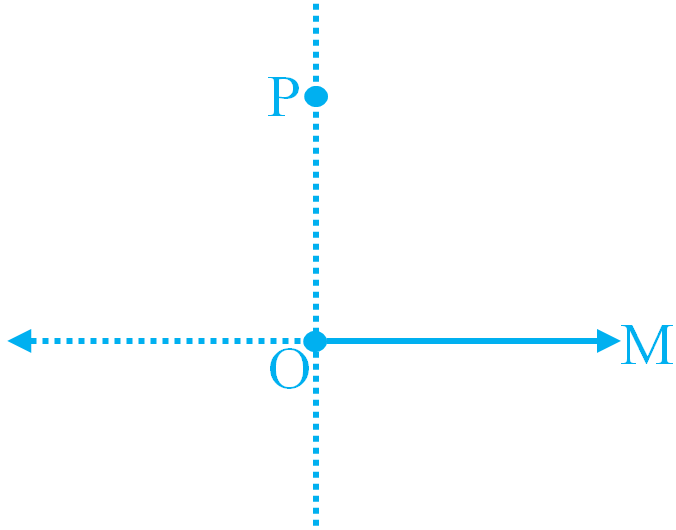
Step $V:$ Join $PM$ along the edge through $P.$ Meeting $m$ at $O.$
Now, $\text{PO}\bot\text{m.}$

$ii.\ $Protractor:
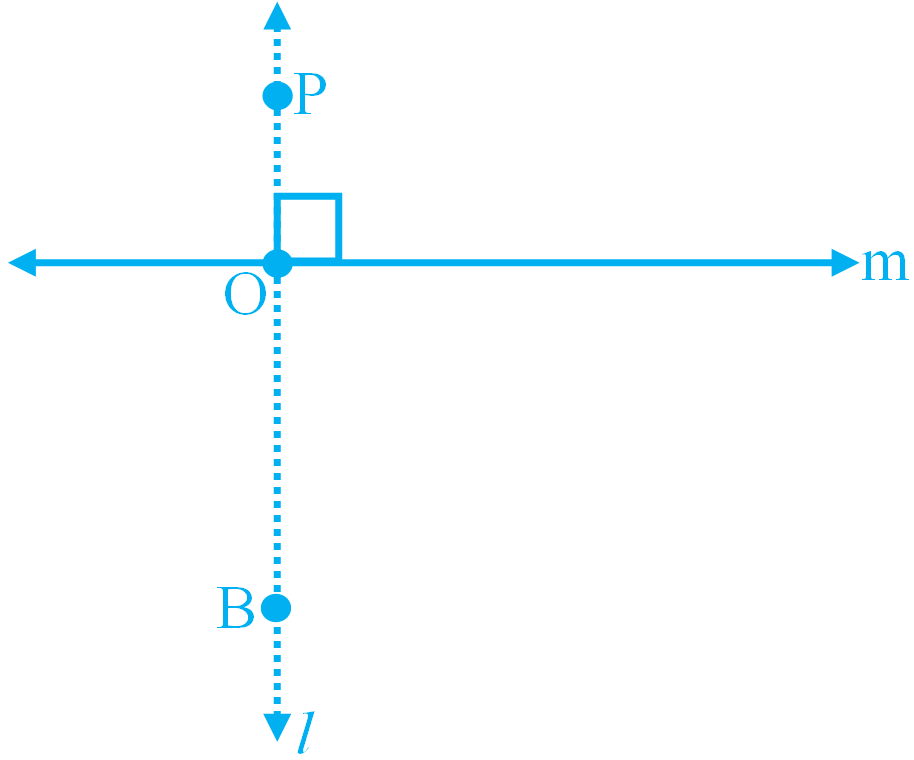
Step $I:$ Let $m$ be the given line and $P$ be a point outside $m.$

Step $II:$ Place the protractor on point $P,$ such that its centre coincides with point $P.$​​​​​​​
Step $III:$ Mark a point $B$ against the $90^\circ$ mark on the protractor.
Step $IV:$ Remove the protractor and draw a line $l$ passing through $P$ and $B$ wich intersects line m at $O.$
Then, $\text{PO}\bot\text{m}.$

$iii.\ $​​​​​​​Ruler and Compass:
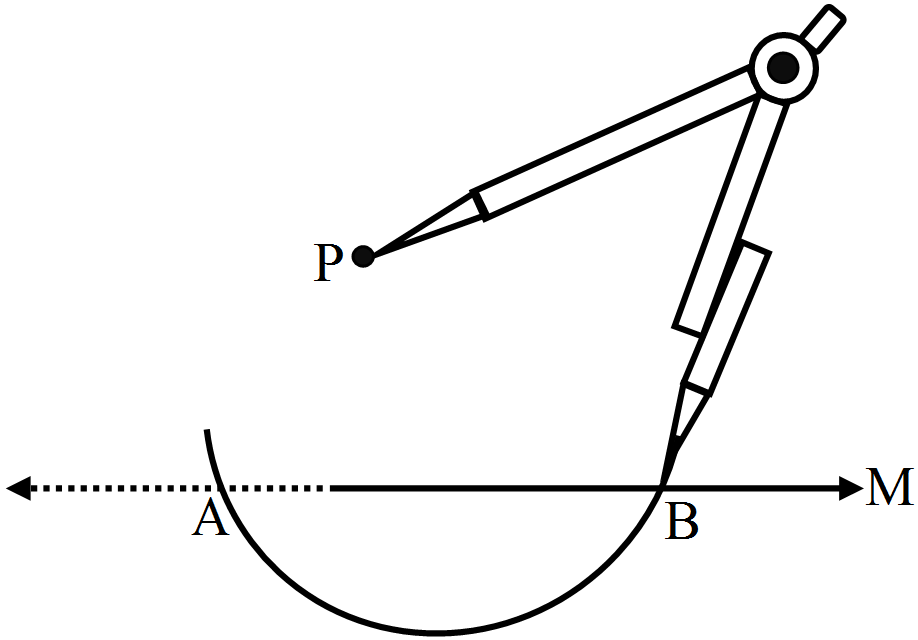
Step $I:$ Given, a line m and point $P,$ not it. Extend the given line in both derections.

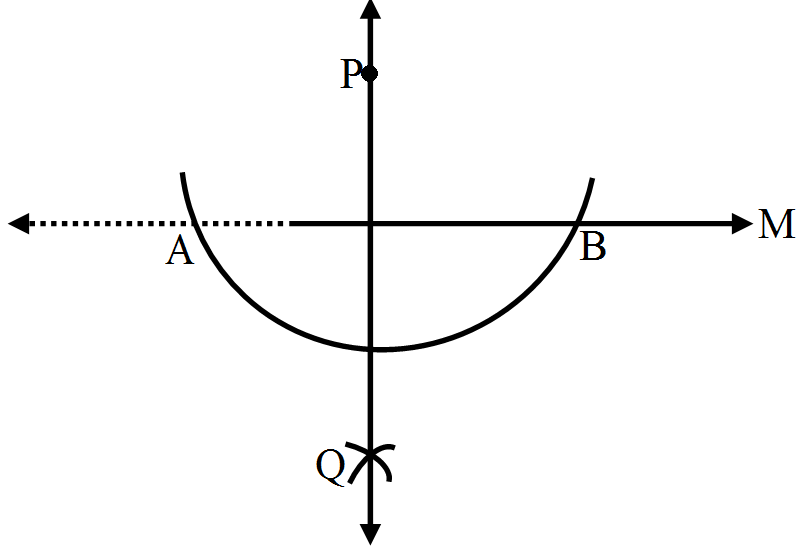
Step $II:$ With $P$ as centre, draw an arc which intersects line m at two points $A$ and $B.$​​​​​​​

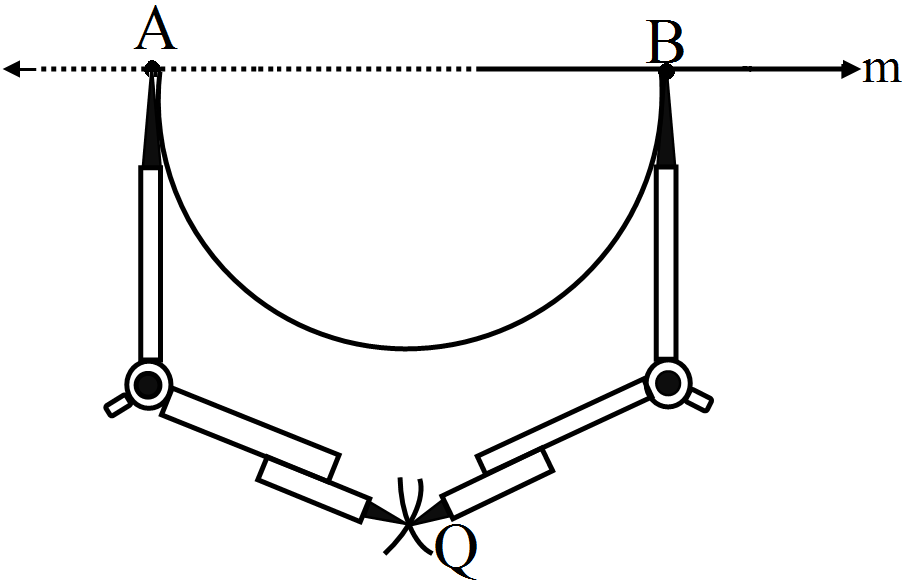
Step $III:$ With $A$ and $B$ as centres and the same redius draw two arcs which intersect at a point say $Q,$ on the other side.

Step $IV:$ Join $PQ.$​​​​​​​

Thus, $PQ$ is perpendicular to $m.$
We are able to draw one perpendicular line.
 

Need a full question paper?

Generate a complete, print-ready paper with questions like this in minutes — across 16+ boards, with answer keys.

Start Generating Free

Similar questions

In the above question, how many square metres of cloth is required to cover all the display boards? What will be the length in m of the cloth used, if its breadth is $120\ cm?$
Simplify:
$7\frac{1}{2}-\Big[2\frac{1}{4}\div\Big\{1\frac{1}{4}-\frac{1}{2}\Big(\frac{3}{2}-\overline{\frac{1}{3}-\frac{1}{6}}\Big)\Big\}\Big]$
Find the greatest number of five digits exactly divisble by $9, 12, 15, 18$ and $24.$
Find the $HCF$ of the numbers in the following using the division method:$658, 940, 1128$
 
The following data gives the amount of mature (in thousand tones) manufactured by a company during some years:
Year $1992$ $1993$ $1994$ $1995$ $1996$ $1997$
Manure (in thousand tonnes) $15$ $35$ $45$ $30$ $40$ $20$
$i.\ $Represent the above data with the help of a bar graph.
$ii.\ $Indicate will the help of the bar graph the year in which the amount of manure manufactured by the company was maximum.
$iii.\ $Choose the correct alternative.
The consecutive years during which there was a maximum decrease in manure production are:
$a.\ 1994$ and $1995$
$b.\ 1992$ and $1993$
$c.\ 1996$ and $1997$
$d.\ 1995$ and $1996$
 
Construct an angle of $90^\circ $ and bisect it.
Draw a rectangle with sides of lengths 8 cm and 6 cm. Also, check whether its opposite sides are equal or not. Measure the lengths of its diagonals and see whether they are equal or not.
Given below are two Columns-Column $I$ and Column $II.$ Match each item of Column $I$ with the corresponding item of Column $II.$
  Column I   Column II
$(i)$ The difference of two consecutive whole numbers. $(a)$ Odd
$(ii)$ The product of two non-zero consecutive whole numbers. $(b)$ $0$
$(iii)$ Quotient when zero is divided by another non-zero whole number. $(c)$ $3$
$(iv)$ $2$ added three times, to the smallest whole number. $(d)$ $1$
$(v)$ Smallest odd prime number. $(e)$ $6$
    $(f)$ Even
Draw any angle with vertex $O.$ Take a point $A$ on one of its arms and $B$ on another such that $OA = OB.$ Draw the perpendicular bisectors of $\overline {OA}$ and $\overline {OB}$. Let them meet at $P.$ Is $PA = PB?$
In a Mathematics test, the marks were obtained by $40$ students. Arrange these marks in a table using tally marks.
$8$ $1$ $3$ $7$ $6$ $5$ $5$ $4$ $4$ $2$
$4$ $9$ $5$ $3$ $7$ $1$ $6$ $5$ $2$ $7$
$7$ $3$ $8$ $4$ $2$ $8$ $9$ $5$ $8$ $6$
$7$ $4$ $5$ $6$ $9$ $6$ $4$ $4$ $6$ $6$
Find how many students obtained marks equal to or more than $7.$