MCQ
Correct energy value order is
  • A
    $ns\;np\;nd(n - 1)f$
  • $ns\;np(n - 1)d\;(n - 2)f$
  • C
    $ns\;np(n - 1)d\;(n - 1)f$
  • D
    $ns(n - 1)d\;n(n - 1)f$

Answer

Correct option: B.
$ns\;np(n - 1)d\;(n - 2)f$
b
(b) Higher the $(n+1)$ value higher is the energy associated with orbitals.

Need a full question paper?

Generate a complete, print-ready paper with questions like this in minutes — across 16+ boards, with answer keys.
Start Generating Free

Similar questions

For the reaction $A(g) + 2B(g) \to 2C(g) + 3D(g)$, the value of $\Delta E$ at ${27\,^o}C$ is $ 19.0\, kcal$ . The value of $\Delta H$ for the reaction would be.......$kcal$  $(R = 2.0\,cal\,{K^{ - 1}}mo{l^{ - 1}})$
Which one of the following elements shows both positive and negative oxidation states?
The maximum number of electrons that can be accommodated in a $3d$ subshell is
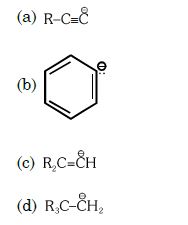
The stability of carbanions in the following is in the order of
Which of the following compounds is chiral ?
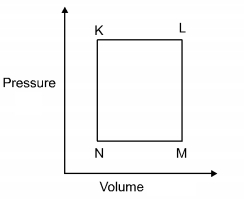
A fixed mass ' $m$ ' of a gas is subjected to transormation of states from $K$ to $L$ to $M$ to $N$ and back to $K$ as shown$Image$

$1.$ The succeeding operations that enable this transformation of states are

$(A)$ Heating, cooling, heating, cooling

$(B)$ Cooling, heating, cooling, heating

$(C)$ Heating, cooling, cooling, heating

$(D)$ Cooling, heating, heating, cooling

$2.$ The pair of isochoric processes among the transormation of states is

$(A)$ $K$ to $L$ and $L$ to $M$

$(B)$ $L$ to $M$ and $N$ to $K$

$(C)$ $L$ to $M$ and $M$ to $N$

$(D)$ $M$ to $N$ and $N$ to $K$

Give the answer question $1$ and $2.$
The hydrocarbon which can react with sodium in liquid ammonia is ____________________ .
Principle functional group in given compound is

$\begin{array}{*{20}{c}}
  {{H_3}C - C - O - C - C{H_2} - O - C{H_3}} \\ 
  {||\,\,\,\,\,\,\,\,\,\,\,\,\,\,\,\,\,\,\,\,||\,\,\,\,\,\,\,\,\,\,\,\,\,\,\,\,\,\,\,\,\,\,\,\,\,\,\,\,\,\,} \\ 
  {O\,\,\,\,\,\,\,\,\,\,\,\,\,\,\,\,\,\,\,O\,\,\,\,\,\,\,\,\,\,\,\,\,\,\,\,\,\,\,\,\,\,\,\,\,\,\,\,\,\,\,} 
\end{array}$
By adding $20\,ml$ $0.1\,N\,HCl$ to $20\,ml$ $0.001\,N\,$ $KOH,$ the $ pH$ of the obtained solution will be
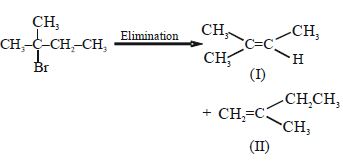
Consider the following reaction Which of the following base will give the best yield of the alkene $II$ as the major product