MCQ
Correct formula of calomel is
  • $H{g_2}C{l_2}$
  • B
    $HgC{l_2}$
  • C
    $HgC{l_2}.{H_2}O$
  • D
    $HgS{O_4}$

Answer

Correct option: A.
$H{g_2}C{l_2}$
a
Correct formula of calomel is $Hg _2 Cl _2$. Calomel is mercurous chloride or mercury $(I)$ chloride. It is used into calomel electrode which is metal-sparingly soluble salt electrode. it is secondary reference electrode.

Need a full question paper?

Generate a complete, print-ready paper with questions like this in minutes — across 16+ boards, with answer keys.
Start Generating Free

Similar questions

Which statement is not true with respect to nitrate ion test ?
Nitration of aniline also gives $m-$nitro aniline, in strong acidic medium because
Which of the following is the most electropositive element
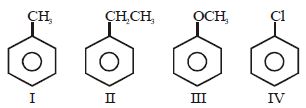
Arrange the following compounds in their correct order of reactivity towards electrophilic substitution reaction
Which orbit of $Be^{+3}$ has the same orbit radius as that of the ground state of hydrogen atom
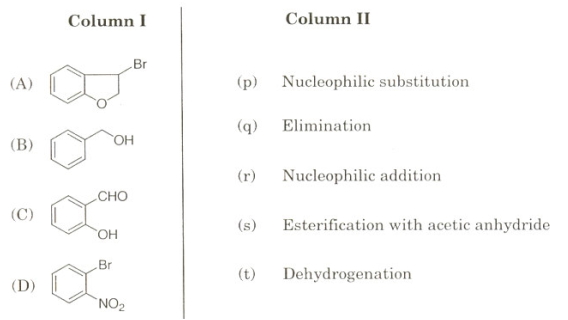
Match each of the compounds given in Column $I$ with the reaction$(s)$, that they can undergo, given in Column $II$.
Consider a reaction $2H_2O_{(l)} \to  2H_{2(g)} + O_{2(g)}$ Calculate the work done at $25\,^oC$ for the decomposition of $36\, ml$ of water ?
Which one of the following compounds has non zero dipole moment?
 Dilution processes of different aqueous solutions, with water, are given in $LIST-I$. The effects of dilution of the solutions on $\left[ H ^{+}\right]$ are given in $LIST-II.($Note: Degree of dissociation $( \alpha )$ of weak acid and weak base is $<<1$; degree of hydrolysis of salt $<<1 ;\left[ H ^{+}\right]$ represents the concentration of $H ^{+}$ ions$)$
$LIST-I$ $LIST-II$
$P(10 \ mL $ of  $0.1 M NaOH +20 \ mL$ of $0.1 M $  acetic acid$)$ diluted to  $60 \ mL$ $1$ the value of $\left[ H ^{+}\right]$ does not change on dilution
$Q (20 \ mL $ of $ 0.1 \ M \ NaOH +20 \ mL $ of $0.1 \ M $ acetic acid$)$ diluted to $ 80\ mL$ $2$ the value of $\left[ H ^{+}\right]$ changes to half of its initial value on dilution the value of $\left[ H ^{+}\right]$ changes to two times of its initial value on dilution
$R(20 \ mL $ of $ 0.1 \ M HCl +20 \ mL$ of $0.1 \ M$ ammonia solution$)$ diluted to $80 \ mL$ $3$ the value of $\left[ H ^{+}\right]$changes to $1 / \sqrt{2}$ times of its initial value on dilution
$S10 \ mL$ saturated solution of Ni $( OH )_2$ in equilibrium with excess
solid  Ni $( OH )_2$ s diluted to  $20 \ mL ($solid  Ni $( OH )_2$ is still present afterdilution$).$
$4$the value of $\left[ H ^{+}\right]$changes to $\sqrt{2}$ times of its initial value on dilution
  $5$ the value of $\left[ H ^{+}\right]$changes to $\sqrt{2}$ times of its initial value on dilution
Match each process given in $LIST-I$ with one or more effect$(s)$ in $LIST-II$. The correct option is
Solid $KClO_3$ is taken in a container maintained at constant pressure of $1\,atm$. Upon heating following equilibrium is obtained
$2KCl{O_3}\left( s \right){\text{ }} \rightleftharpoons \,\,2KCl\left( s \right){\text{ }} + {\text{ }}3{O_2}\left( g \right)$

If $\Delta H^o = 25\,kcal/mol$ and $\Delta S^o = 50\,cal/K,$ at what temperature equilibrium will be established in the container. (Ignore variation of $\Delta H^o$ and $\Delta S^o$ with temperature.).......$K$