MCQ
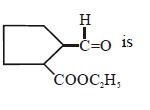
Correct name of
  • A
    $2-$ oxocyclopentanecarboxylate
  • B
    $2-$ Formylcyclopentanecarboxylate
  • Ethyl $-2-$ formylcyclopentanecarboxylate
  • D
    Ethyl $-2-$ oxocyclopentanecarboxylate

Answer

Correct option: C.
Ethyl $-2-$ formylcyclopentanecarboxylate
c

Need a full question paper?

Generate a complete, print-ready paper with questions like this in minutes — across 16+ boards, with answer keys.

Start Generating Free

Similar questions

The equivalent conductance of monobasic acid at infinite dilution is $348\, ohm^{-1}\, cm^2\, eq^{-1}$ . If the resistivity of the solution containing $15\, g$ acid (mol. wt. $49$ ) in $1$ $litre$ is $18.5\, ohm\, cm$ . What is the degree of dissociation of acid? .............. $\%$
$HSO_4^ - $ is the conjugate base of
Which of the following is paramagnetic
The equilibrium constant for the reversible reaction, ${N_2} + 3{H_2}$ $\rightleftharpoons$ $2N{H_3}$ is $K$ and for the reaction $\frac{1}{2}{N_2} + \frac{3}{2}{H_2}$ $\rightleftharpoons$ $N{H_3}$ the equilibrium constant is $K'$. $K$ and $K'$ will be related as
Assertion: A mixture of $He$ and $O_2$ is used for respiration for deep sea divers.

Reason: $He$ is soluble in blood.

For the transformation the reagent used is
If the value of azimuthal quantum number is $3$ , the possible values of magnetic quantum number would be
For the given compound $X$, the total number of optically active stereoisomers is. . . . . . .
Match the electronic configurations in List-$I$ with appropriate metal complex ions in List-$II$ and choose the correct option.

[Atomic Number: $\mathrm{Fe}=26, \mathrm{Mn}=25, \mathrm{Co}=27$ ]

List-$I$ List-$II$
($P$) $ t_{2 g}^6 e_g^0$ ($1$)$\left[\mathrm{Fe}\left(\mathrm{H}_2 \mathrm{O}\right)_6\right]^{2+}$
($Q$) $t_{2 g}^3 e_g^2$ ($2$) $\left[\mathrm{Mn}\left(\mathrm{H}_2 \mathrm{O}\right)_6\right]^{2+}$
($R$) $e^2 t_2^3$ ($3$)$\left[\mathrm{Co}\left(\mathrm{NH}_3\right)_6\right]^{3+}$
($S$) $t_{2 g}^{+} e_g^2$ ($4$)$\left[\mathrm{FeCl}_4\right]^{-}$
  $\left[\mathrm{CoCl}_4\right]^{2-}$


At $27\,^oC$, $1$ $mole$ of an ideal gas expand in reversible and isothermally from $2\, atm$ to $1\, atm$ then $\Delta H$ will be......$KJ$
