MCQ
Correct order of bond length is
  • $CO_3^{2 - } > C{O_2} > CO$
  • B
    $C{O_2} > CO > CO_3^{2 - }$
  • C
    $CO > C{O_2} > CO_3^{2 - }$
  • D
    None of these

Answer

Correct option: A.
$CO_3^{2 - } > C{O_2} > CO$
(a) From valency bond theory, bond order in $CO$,

i.e. $:\mathop C\limits^ - \equiv \mathop O\limits^ + :$ is $3,$ that of $O = C = O$ is $2$ 

while that of $CO_3^{2 - }$ ion is $1.33.$

Since the bond length increases as the bond order decreases, i.e. $CO < C{O_2} < CO_3^{2 - }$.

Need a full question paper?

Generate a complete, print-ready paper with questions like this in minutes — across 16+ boards, with answer keys.
Start Generating Free

Similar questions

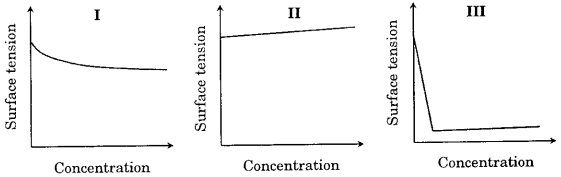
The qualitative sketches $I, II$ and $III$ given below show the variation of surface tension with molar concentration of three different aqueous solutions of $\mathrm{KCl}, \mathrm{CH}_3 \mathrm{OH}$ and $\mathrm{CH}_3\left(\mathrm{CH}_2\right)_{11} \mathrm{OSO}_3{ }^{-} \mathrm{Na}^{+}$at room temperature. The correct assignment of the sketches is
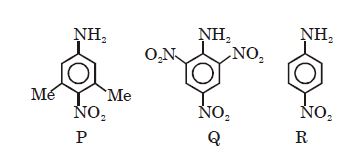
Order of basic strength
$IUPAC$ name of ${(C{H_3})_2}CH - CH = CH - C{H_3}$ is
If the solubility product of $AgBr{O_3}$ and $A{g_2}S{O_4}$ are $5.5 \times {10^{ - 5}}$ and $2 \times {10^{ - 5}}$ respectively, the relationship between the solubilities of these can be correctly represented as
The statement “If $0.003 $ moles of a gas are dissolved in $900 g $ of water under a pressure of $ 1$  atmosphere, $0.006 $ moles will be dissolved under a pressure of  $2 $ atmospheres”, illustrates
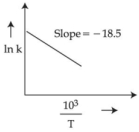
The rate constants for decomposition of acetaldehyde have been measured over the temperature range $700-1000\, K$. The data has been analysed by plotting $ln\, k\,$vs$\,\frac{10^{3}}{ T }$ graph. The value of activation energy for the reaction is $......\,kJ mol ^{-1}$. (Nearest integer) (Given : $R =8.31\, J \,K ^{-1} \,mol ^{-1}$ )
Which of the following substances has the least covalent character ?
Calculate the standard heat of formation of carbon disulphide $(l)$, given that the standard heat of combustion of carbon $(s)$, sulphur $(s)$ and carbon disulphide $(l)$ are $ - 393.3,\, - 293.72$ and $ - 1108.76\,kJ\,mo{l^{ - 1}}$ respectively ......$kJ\,mo{l^{ - 1}}$
In ${S_{{N^2}}}$ reactions, the correct order of reactivity for the following compounds :
Elements of atomic number $6$ is placed in