MCQ
Correct relation for triode is
 
  • $\mu=g_m \times r_p$
  • B
    $\mu=\frac{g_m}{r_p}$
  • C
    $\mu=2 g_{ m } \times r _{ p }$
  • D
    None of these

Answer

Correct option: A.
$\mu=g_m \times r_p$
(a) $\mu=g_m \times r_p$

Need a full question paper?

Generate a complete, print-ready paper with questions like this in minutes — across 16+ boards, with answer keys.

Start Generating Free

Similar questions

Two positive point charges of $12\,\mu C$ and $8\,\mu C$ are $10\,cm$ apart. The work done in bringing them $4\, cm$ closer is
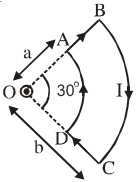
A current loop $ABCD$ is held fixed on the plane of the paper as shown in the figure. The arcs $ BC$ (radius $= b$) and $DA $ (radius $= a$) of the loop are joined by two straight wires $AB $  and $CD$. A steady current $I$ is flowing in the loop. Angle made by $AB$ and $CD$ at the origin $O$ is $30^o $. Another straight thin wire with steady current $I_1$ flowing out of the plane of the paper is kept at the origin.

The magnitude of the magnetic field $(B)$ due to the loop $ABCD$ at the origin $(O)$ is :
Magnetic field can be defined as the:
The intensity of magnetic field is H and moment of magnet is M. The maximum potential energy is
Given below are two statements :

Statement $I :$ Stopping potential in photoelectric effect does not depend on the power of the light source.

Statement $II :$ For a given metal, the maximum kinetic energy of the photoelectron depends on the wavelength of the incident light.

In the light of above statements, choose the most appropriate answer from the options given below.

Options :

On increasing the number of electrons striking the anode of an $X-$ ray tube, which one of the following parameters of the resulting $X-$ rays would increase
In Milikan’s experiment, an oil drop having charge $q$ gets stationary on applying a potential difference $V$ in between two plates separated by a distance $‘d’$. The weight of the drop is
When light of wavelength $300 \;nm$ (nanometer) falls on a photoelectric emitter, photoelectrons are liberated. For another emitter, however light of $600\; nm$ wavelength is sufficient for creating photoemission. What is the ratio of the work functions of the two emitters
In a meter bridge experiment null point is obtained at $20\, cm$ from one end of the wire when resistance $X$ is balanced against another resistance $Y$. If $X < Y$, then where will be the new position of the null point from the same end, if one decides to balance a resistance of $4X$ against $Y$ ........... $cm$
In case of displacement method of lenses, the product of magnification in both cases is