MCQ
Correct relation for triode is
  • $\mu=g_m \times r_p$
  • B
    $\mu=\frac{\frac{g m}{r_p}}{r_p}$
  • C
    $\mu=2 g_m \times r_p$
  • D
    None of these

Answer

Correct option: A.
$\mu=g_m \times r_p$

Need a full question paper?

Generate a complete, print-ready paper with questions like this in minutes — across 16+ boards, with answer keys.

Start Generating Free

Similar questions

The minimum distance between an object and its real image formed by a convex lens is(a) 1.5 f (b) 2 f (c) 2.5 f(d) 4 f
       
A point $Q$ lies on the perpendicular bisector of an electrical dipole of dipole moment $p$. If the distance of $Q$  from the dipole is $r\ ($much larger than the size of the dipole$),$ then electric field at $Q$ is proportional to
For making standard resistance, wire of following material is used:
The torque ($\vec{\tau}$) experienced by a current loop of magnetic momvent $(\overrightarrow{ M })$ placed in magnetic field $\vec{B}$ is :
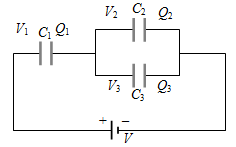
In an adjoining figure are shown three capacitors $C_1, C_2$ and $C _3$ joined to a battery. The correct condition will be $($Symbols have their usual meanings$)$
Same current is flowing through two parallel conducting wires at a distance $d$ in opposite directions. The intensity of magnetic field at the midpoint between the wires is :
Seven capacitors each of capacity $2\ \mu F$ are to be so connected to have a total capacity $\frac{10}{11}\ \mu F$. Which will be the necessary figure as shown
Consider the following two statements regarding a linearly polarised, plane electromagnetic wave:
  1. The electric field and the magnetic field have equal average values.
  2. The electric energy and the magnetic energy have equal average values.
The width of forbidden energy gap in the semiconductor is approximately :
Assertion :  In everyday life the Doppler’s effect is observed readily for sound waves than light waves.
Reason     : Velocity of light is greater than that of sound.(a) If both assertion and reason are true and the reason is the correct explanation of the assertion.(b) If both assertion and reason are true but reason is not the correct explanation of the assertion.(c) If assertion is true but reason is false.(d) If the assertion and reason both are false.