Correct set up to verify Ohm's law is
JEE MAIN 2013, Diffcult
Download our app for free and get started
In ohm's law, we check $\mathrm{V}=$ $IR$ where $I$ is the corrent flowing through a resistor and $V$ is the potential difference across that resistor.
Only option $(a)$ fits the above criteria.
Remember that ammeter is connected in scries with resistance and vditmeter parallel with the resistance.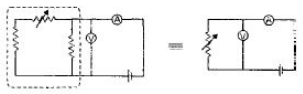

Download our appand get started for free
Experience the future of education. Simply download our apps or reach out to us for more information. Let's shape the future of learning together!No signup needed.*
Similar Questions
- 1View SolutionIf a high power heater is connected to electric mains, then the bulbs in the house become dim, because there is a
- 2The current in a conductor varies with time t as $I = 2t + 3{t^2}$ where $I$ is in ampere and $t$ in seconds. Electric charge flowing through a section of the conductor during $t = 2\,\sec$ to $t = 3\,\sec$ is ............. $C$View Solution
- 3$A$ battery consists of a variable number $n$ of identical cells having internal resistance connected in series. The terminals of the battery are short circuited and the current $I$ measured. Which one of the graph below shows the relationship between $I$ and $n$?View Solution
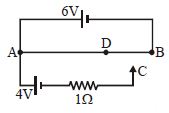
- 4A $6\, volt$ battery of negligible internal resistance resistance is connected across a uniform wire $AB$ of length $100\,cm$. The positive terminal of another battery of $emf$ $4\,V$ and internal resistance $1\,\Omega $ is joined to the point $A$ as shown in fig. Take the potential at $B$ to be zero. At which point $D$ of the wire $AB$, from left the potential is equal to the potential at $C$ ? ...................... $cm$ (approximately)View Solution
- 5Assertion : A larger dry cell has higher $emf$View Solution
Reason : The $emf$ of a dry cell is proportional to its size
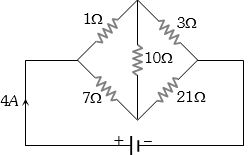
- 6In the circuit shown in figure, the current drawn from the battery is $4\,A$. If $10 \,\Omega$ resistor is replaced by $20\,\Omega$ resistor, then current drawn from the circuit will be .............. $A$View Solution
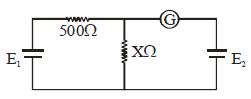
- 7In the adjoining circuit, the battery $E_1$ has an emf of $12\, volt$ and zero internal resistance while the battery $E_2$ has an $emf$ of $2\, volt$. If the galvanometer $G$ reads zero, then the value of the resistance $X$ (in $ohm$ ) isView Solution
- 8The current in the primary circuit of a potentiometer is $0.2\, A$. The specific resistance and cross section of the potentiometer wire are $4\times10^{-7}\,ohm$ $metre$ and $8\times10^{-7}\, m^2$ respectively. The potential gradient will be equal to .............. $V/m$View Solution
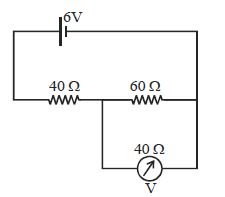
- 9The reading of voltmeter in the circuit shown is ............. $V$View Solution
- 10A copper wire of resistance $R$ is cut into ten parts of equal length. Two pieces each are joined in series and then five such combinations are joined in parallel. The new combination will have a resistanceView Solution