MCQ
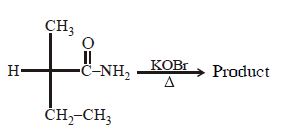
Correct statement about product is
- AIt is optically inactive
- ✓It is optically active and having one less carbon than reactant
- CProduct do not give isocyanide test
- DProduct is carboxylic acid
Generate a complete, print-ready paper with questions like this in minutes — across 16+ boards, with answer keys.
$(I)$ $\begin{array}{*{20}{c}}
{{C_6}{H_5} - CH - Cl} \\
{\,\,|} \\
{\,\,\,\,\,\,\,\,\,C{H_3}}
\end{array}\xrightarrow[{5\% \,\,water}]{{95\% \,\,\,acetone}}\begin{array}{*{20}{c}}
{{C_6}{H_5} - CH - OH} \\
| \\
{\,\,\,\,\,\,C{H_3}}
\end{array}$
$(II)$ $\begin{array}{*{20}{c}}
{{C_6}{H_5} - CH - Cl} \\
{\,\,|} \\
{\,\,\,\,\,\,C{H_3}}
\end{array}\xrightarrow[{10\% \,\,water}]{{90\% \,\,\,acetone}}\begin{array}{*{20}{c}}
{{C_6}{H_5} - CH - OH} \\
| \\
{\,\,\,\,\,\,C{H_3}}
\end{array}$
$(III)$ $\begin{array}{*{20}{c}}
{{C_6}{H_5} - CH - Cl} \\
{\,\,|} \\
{\,\,\,\,\,\,C{H_3}}
\end{array}\xrightarrow[{20\% \,\,water}]{{80\% \,\,\,acetone}}\begin{array}{*{20}{c}}
{{C_6}{H_5} - CH - OH} \\
| \\
{\,\,\,\,\,\,C{H_3}}
\end{array}$
$(IV)$ $\begin{array}{*{20}{c}}
{{C_6}{H_5} - CH - Cl} \\
{\,\,|} \\
{\,\,\,\,\,\,C{H_3}}
\end{array}\xrightarrow{{100\% \,water}}\begin{array}{*{20}{c}}
{{C_6}{H_5} - CH - OH} \\
| \\
{\,\,\,\,\,\,C{H_3}}
\end{array}$
Arrange these reactions in decreasing order of greater proportion of inverted product and select correct answer from the codes given below :