MCQ
Correct statement is
  • A
    $N{H_4}Cl$ gives alkaline solution in water
  • B
    $C{H_3}COONa$ gives acidic solution in water
  • $C{H_3}COOH$ is a weak acid
  • D
    $N{H_4}OH$ is a strong base

Answer

Correct option: C.
$C{H_3}COOH$ is a weak acid
(c) $C{H_3}COOH$ is weak acid shows dissociation equilibrium as

$C{H_3}COOH⇌C{H_3}CO{O^ - } + {H^ + }$

Need a full question paper?

Generate a complete, print-ready paper with questions like this in minutes — across 16+ boards, with answer keys.

Start Generating Free

Similar questions

The entropy change when $2\, moles$ of ideal monoatomic gas is heated from $200\,^oC$ to $300\,^oC$ and isochorically
The outer electronic configuration of $Gd \ (At. \ No. \ 64)$ is
Which of the following is the most stable cation
A petroleum fraction having boiling range $70-200\,^oC$ and containing $6-10$ carbon atoms per molecule is called
The number of $\sigma $ bonds in o-xylene is
$Xe{F_2}$ involves hybridisation
For the reaction $(1)$ and $(2)$ :
$A \rightleftharpoons  B + C ....(1)$
$D \rightleftharpoons  2E ....(2)$
Given $K_{P_1} : K_{P_2} : : 9 : 1$
If the degree dissociation of $A$ and $D$ be same then the total pressure at equilibria $(1)$ and $(2)$ are in the ratio (Assume reaction are started with equal number of moles of $A$ and $D$).
${H_3}B{O_3}\,\xrightarrow{{{T_1}}}X\,\xrightarrow{{{T_2}}}Y\,\xrightarrow{{\operatorname{Re} d\,\,\,hot}}{B_2}{O_3}$

if $T_1 < T_2$ then $X$ and $Y$ respectively are

Oxidising power of chlorine in aqueous solution can be determined by the parameters indicated below :

$\frac{1}{2}C{l_2}(g)\xrightarrow{{\frac{1}{2}{\Delta _{diss}}{H^\Theta }}}Cl(g)\xrightarrow{{{\Delta _{eg}}{H^\Theta }}}$ $C{l^ - }(g)\xrightarrow{{{\Delta _{Hyd}}{H^\Theta }}}C{l^ - }(aq)$

(using the data, 

${{\Delta _{diss}}H_{C{l_2}}^\Theta } = 240\,kJ\,mol^{-1}, {{\Delta _{eg}}H_{C{l}}^\Theta }= -349 \,kJ\,mol^{-1},$${{\Delta _{Hyd}}H_{C{l}}^\Theta }= -381 \,kJ\,mol^{-1}$ ) will be ............. $\mathrm{kJ\,mol}^{-1}$
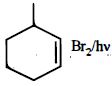
The major product of the following reaction is