MCQ
Corrosion is basically a
  • A
    Altered reaction in presence of ${H_2}O$
  • Electrochemical phenomenon
  • C
    Interaction
  • D
    Union between light metal and heavy metal

Answer

Correct option: B.
Electrochemical phenomenon
b
Corrosion is an electrochemical phenomenon.

Need a full question paper?

Generate a complete, print-ready paper with questions like this in minutes — across 16+ boards, with answer keys.

Start Generating Free

Similar questions

The equilibrium $\mathrm{Cr}_2 \mathrm{O}_7^{2-} \rightleftharpoons 2 \mathrm{CrO}_4^{2-}$ is shifted to the right in :
For lead storage battery pick the correct statements

$A.$ During charging of battery, $PbSO _4$ on anode is converted into $PbO _2$

$B.$ During charging of battery, $PbSO _4$ on cathode is converted into $PbO _2$

$C.$ Lead storage battery, consists of grid of lead packed with $PbO _2$ as anode

$D.$ Lead storage battery has $\sim 38 \%$ solution of sulphuric acid as an electrolyte

Choose the correct answer from the options given below:
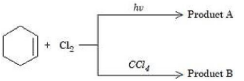
Identify product A and product B : 
Image
A $1.84\,mg$ sample of polyhydric alcoholic compound ' $X$ ' of molar mass $92.0\,g / mol$ gave $1.344\,mL$ of $H _{2}$ gas at $STP$. The number of alcoholic hydrogens present in compound ' $X$ ' is $.....$
major product $X$ is
In $s-$ block on moving down the group reactivity of metals with water and air increases, which of the following factor has no significance for this trend of reactivity 
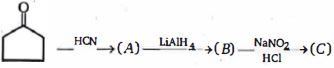
End product $(C)$ in above, reaction is
Which of the following compounds will show metamerism
Consider an electrochemical cell: $A ( s )\left| A ^{ n +}( aq , 2 M ) \| B ^{2 n +}( aq , 1 M )\right| B ( s )$. The value of $\Delta H ^{\ominus}$ for the cell reaction is twice that of $\Delta G ^{\ominus}$ at $300 K$. If the emf of the cell is zero,  the $\Delta S ^{\ominus}$ (in $J K ^{-1} mol ^{-1}$ ) of the cell reaction per mole of $B$ formed at $300 K$ is. . . . . . . (Given: $\ell n (2)=0.7, R$ (universal gas constant) $=8.3 J K ^{-1} mol ^{-1} . H , S$ and $G$ are enthalpy, entropy and Gibbs energy, respectively.)
The electronic configuration of four elements are

$(I)\,[Kr]\,5s^1$                                  $(II)\, [Rn]\,5f^{14}\,6d^1\,7s^2$ 

$(III)\,[Ar]\,3d^{10}\,4s^2\,4p^5$           $(IV)\,[Ar]\,3d^6\,4s^2$
Consider the following Statements

$(i)\, I$ shows variable oxidation State

$(ii)\, II$ is a $d-block$ element
$(iii)$ The compound formed between $I$ and $III$ is covalent
$(iv)\,IV$ shows single oxidation state
Which Statement is True $(T)$ or False $(F)$?