MCQ
${\cot ^{ - 1}}\frac{3}{4} + {\sin ^{ - 1}}\frac{5}{{13}} = $
  • ${\sin ^{ - 1}}\frac{{63}}{{65}}$
  • B
    ${\sin ^{ - 1}}\frac{{12}}{{13}}$
  • C
    ${\sin ^{ - 1}}\frac{{65}}{{68}}$
  • D
    ${\sin ^{ - 1}}\frac{5}{{12}}$

Answer

Correct option: A.
${\sin ^{ - 1}}\frac{{63}}{{65}}$
a
(a) Let ${\cot ^{ - 1}}\frac{3}{4} = \theta \,\, \Rightarrow \,\,\cot \theta = \frac{3}{4}$

and $\sin \theta = \frac{1}{{\sqrt {1 + {{\cot }^2}\theta } }} = \frac{1}{{\sqrt {1 + (9/16)} }} = \frac{4}{5}$

Hence ${\cot ^{ - 1}}\frac{3}{4} + {\sin ^{ - 1}}\frac{5}{{13}} = {\sin ^{ - 1}}\frac{4}{5} + {\sin ^{ - 1}}\frac{5}{{13}}$

$ = {\sin ^{ - 1}}\left[ {\frac{4}{5}.\sqrt {1 - \frac{{25}}{{169}}} + \frac{5}{{13}}.\,\sqrt {1 - \frac{{16}}{{25}}} } \right]$

$ = {\sin ^{ - 1}}\left[ {\frac{4}{5}.\frac{{12}}{{13}} + \frac{5}{{13}}.\frac{3}{5}} \right]$

$ = {\sin ^{ - 1}}\left[ {\frac{{48 + 15}}{{65}}} \right] = {\sin ^{ - 1}}\frac{{63}}{{65}}$.

Need a full question paper?

Generate a complete, print-ready paper with questions like this in minutes — across 16+ boards, with answer keys.

Start Generating Free

Similar questions

$f : R \to R$ is defined as

$f(x) = \left\{ {\begin{array}{*{20}{c}}
{{x^2} + 2mx - 1\,,}&{x \leq 0}\\
{mx - 1\,\,\,\,\,\,\,\,\,\,\,\,\,,}&{x > 0}
\end{array}} \right.$

 If $f (x)$ is one-one then the set of values of $'m'$ is
$\int {{x^3}\log x\,\,dx = } $
If $A$ is an invertible matrix of order $2,$ then ${{{\rm{A}}^{ - 1}}}$ is equal to
If $y = \sqrt {(1 - x)(1 + x)} $, then
The area bounded by the parabola x = 4 - y2 and y-axis, in square units, is:
  1. $\frac{3}{32}$
  2. $\frac{32}{3}$
  3. $\frac{33}{2}$
  4. $\frac{16}{3}$
A particle moves along the curve $y = x^{3/2}$ in the first quadrant in such a way that its distance from the origin increases at the rate of $11$ units per second. The value of $\frac{{dx}}{{dt}}$ when $x = 3$ is
For real numbers $\alpha, \beta, \gamma$ and $\delta,$ if  $\int \frac{\left(x^{2}-1\right)+\tan ^{-1}\left(\frac{x^{2}+1}{x}\right)}{\left(x^{4}+3 x^{2}+1\right) \tan ^{-1}\left(\frac{x^{2}+1}{x}\right)} d x$  $=\alpha \log _{e}\left(\tan ^{-1}\left(\frac{x^{2}+1}{x}\right)\right)$ $+\beta \tan ^{-1}\left(\frac{\gamma\left(x^{2}-1\right)}{x}\right)+\delta \tan ^{-1}\left(\frac{x^{2}+1}{x}\right)+C$  where $C$ is an arbitrary constant, then the value of $10(\alpha+\beta \gamma+\delta)$ is equal to ....... .
The function $f(x)\, = \left\{ \begin{array}{l}x + 2\,\,\,\,,\,\,\,1 \le x \le 2\\4\,\,\,\,\,\,\,\,\,\,\,,\,\,\,x = 2\\3x - 2\,\,,\,\,\,x > 2\end{array} \right.$ is continuous at
The integrating factor of the differential equation $\frac{{dy}}{{dx}} = y\tan x - {y^2}\sec x,$is
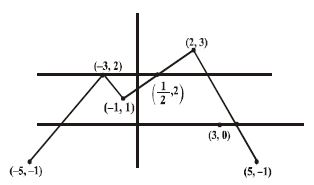
The graph of $y = f(x)$ is shown then number of solutions of the equation $f(f(x)) =2$ is