MCQ
Coulomb force and gravitational force follows the:
  • A
    Conservation law.
  • Inverse square law.
  • C
    Both $a$ and $b.$
  • D
    None.

Answer

Correct option: B.
Inverse square law.

Need a full question paper?

Generate a complete, print-ready paper with questions like this in minutes — across 16+ boards, with answer keys.

Start Generating Free

Similar questions

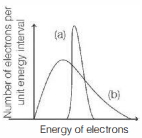
Originally the radioactive beta decay was thought as a decay of a nucleus with the emission of electrons only (Case $I$) . However, in addition to the electron, another (nearly) massless and electrically neutral particle is also emitted (Case $II$). Based on the figure below, which of the following is correct?
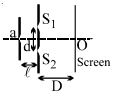
The figure shows a schematic diagram showing the arrangement of Young's Double Slit Experiment Identify the correct statement $(s)$ if the source slit $S$ moved closer to $S_1S_2$, i.e. the distance $\lambda$ decreases
If an electron revolves around a nucleus in a circular orbit of radius $R$ with frequency $n$, then the magnetic field produced at the centre of the nucleus will be
The relation among $u, v$ and $f$ for a mirror is:
A free electron of $2.6\, {eV}$ energy collides with a ${H}^{+}$ ion. This results in the formation of a hydrogen atom in the first excited state and a photon is released. Find the frequency of the emitted photon. $\left({h}=6.6 \times 10^{-34}\, {J} {s}\right)$
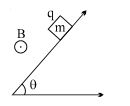
A block of mass $m$ $\&$ charge $q$ is released on a long smooth inclined plane magnetic field $B$ is constant, uniform, horizontal and parallel to surface as shown. Find the time from start when block loses contact with the surface.
The maximum focal length of the eye$-$lens of a person is greater than its distance from the retina. The eye is:
In Young’s double slit experiment, the aperture screen distance is 2m. The fringe width is 1 mm. Light of 600 nm is used. If a thin plate of glass (m = 1.5) of thickness 0.06 mm is placed over one of the slits, then there will be a lateral displacement of the fringes by
A photon, an electron and a uranium nucleus all have the same wavelength. The one with the most energy
A series AC circuit has a resistance of $4\Omega$ and a reactance of $3\Omega.$ The impedance of the circuit is: