Question
Coulomb's law for electrostatic force between two point charges and Newton's law for gravitational force between two stationary point masses, both have inverse-square dependence on the distance between the charges and masses respectively. (a) Compare the strength of these forces by determining the ratio of their magnitudes (i) for an electron and a proton and (ii) for two protons. (b) Estimate the accelerations of electron and proton due to the electrical force of their mutual attraction when they are $1 \mathring A\left(=10^{-10} m \right)$ apart? $\left(m_p=1.67 \times\right.$ $\left.10^{-27} kg , m_e=9.11 \times 10^{-31} kg \right)$
Answer

(a) (i) The electric force between an electron and a proton at a distance $r$ apart is:
$
F_e=-\frac{1}{4 \pi \varepsilon_0} \frac{e^2}{r^2}
$
where the negative sign indicates that the force is attractive. The corresponding gravitational force (always attractive) is:
$
F_G=-G \frac{m_p m_e}{r^2}
$
where $m_p$ and $m_e$ are the masses of a proton and an electron respectively.
$
\left|\frac{F_e}{F_G}\right|=\frac{e^2}{4 \pi \varepsilon_0 G m_p m_e}=2.4 \times 10^{39}
$

(ii) On similar lines, the ratio of the magnitudes of electric force to the gravitational force between two protons at a distance $r$ apart is:
$
\left|\frac{F_e}{F_G}\right|=\frac{e^2}{4 \pi \varepsilon_0 G m_p m_p}=1.3 \times 10^{36}
$
However, it may be mentioned here that the signs of the two forces are different. For two protons, the gravitational force is attractive in nature and the Coulomb force is repulsive. The actual values of these forces between two protons inside a nucleus (distance between two protons is $\sim 10^{-15} m$ inside a nucleus) are $F_{ e } \sim 230 N$, whereas, $F_{ G } \sim 1.9 \times 10^{-34} N$.
The (dimensionless) ratio of the two forces shows that electrical forces are enormously stronger than the gravitational forces.

(b) The electric force $F$ exerted by a proton on an electron is same in magnitude to the force exerted by an electron on a proton; however, the masses of an electron and a proton are different. Thus, the magnitude of force is
$
\begin{aligned}
| F | & =\frac{1}{4 \pi \varepsilon_0} \frac{e^2}{r^2}=8.987 \times 10^9 Nm ^2 / C ^2 \times\left(1.6 \times 10^{-19} C \right)^2 /\left(10^{-10} m \right)^2 \\
& =2.3 \times 10^{-8} N
\end{aligned}
$
Using Newton's second law of motion, $F=m a$, the acceleration that an electron will undergo is
$
a=2.3 \times 10^{-8} N / 9.11 \times 10^{-31} kg =2.5 \times 10^{22} m / s ^2
$

Comparing this with the value of acceleration due to gravity, we can conclude that the effect of gravitational field is negligible on the motion of electron and it undergoes very large accelerations under the action of Coulomb force due to a proton.
The value for acceleration of the proton is
$
2.3 \times 10^{-8} N / 1.67 \times 10^{-27} kg =1.4 \times 10^{19} m / s ^2
$

Need a full question paper?

Generate a complete, print-ready paper with questions like this in minutes — across 16+ boards, with answer keys.

Start Generating Free

Similar questions

When the sun is directly overhead, the surface of the earth receives $1.4 \times 10^3$ W m$^{-2}$ of sunlight. Assume that the light is monochromatic with average wavelength 500nm and that no light is absorbed in between the sun and the earth's surface. The distance between the sun and the earth is $1.5 \times 10^{11}m$.
  1. Calculate the number of photons falling per second on each square metre of earth's surface directly below the sun.
  2. How many photons are there in each cubic metre near the earth's surface at any instant?
  3. How many photons does the sun emit per second?
A glass window is to be fit in an aluminium frame. The temperature on the working day is $40^{\circ} \mathrm{C}$ and the glass window measures exactly $20 \mathrm{~cm} \times 30 \mathrm{~cm}$. What should be the size of the aluminium frame so that there is no stress on the glass in winter even if the temperature drops to $0^{\circ} \mathrm{C}$ ? Coefficients of linear expansion for glass and aluminium are $9.0 \times 10^{-6}{ }^{\circ} \mathrm{C}^{-1}$ and $24 \times 10^{-6}{ }^{\circ} \mathrm{C}^{-1}$ respectively.
A compound microscope consists of an objective lens of focal length 2.0 cm and an eyepiece of focal length 6.25 cm separated by a distance of 15 cm. How far from the objective should an object be placed in order to obtain the final image at (a) the least distance of distinct vision (25 cm), and (b) at infinity? What is the magnifying power of the microscope in each case?
Find the rms speed of hydrogen molecules in a sample of hydrogen gas at 300K. Find the temperature at which the rms speed is double the speed calculated in the previous part.
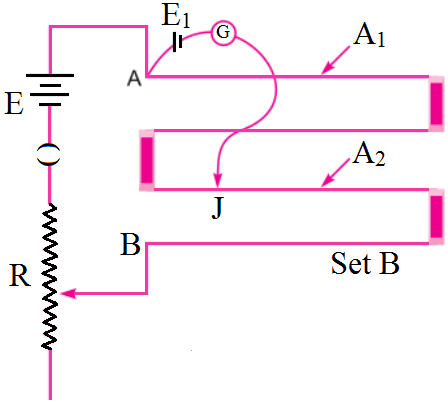
You are given two sets of potentiometer circuits to measure the emf $E_1 $ of a cell. Set A: consists of a potentiometer wire of a material of resistivity $\rho_1$, area of cross-section $A_1$ and length l. Set B: consists of a potentiometer of two composite wire of equal lengths $\frac{\text{l}}2{}$ each, of resistivity $\rho_1,\rho_2$ and area of cross-section $A _1,A_2$ respectively.

Find the relation between resistivity of the two wires with respect to their area of cross section, if the current flowing in the two sets is same. Compare the balancing length obtained in the two sets.
A long, straight wire carries a current i. Let $B_1,$ be the magnetic field at a point Pat a distance d from the wire. Consider a section of length l of this wire such that the point P lies on a perpendicular bisector of the section. Let B2 be the magnetic field at this point due to this section only. Find the value of $\frac{\text{d}}{\text{l}}$ so that $B_2$ differs from $B_1$, by 1%.
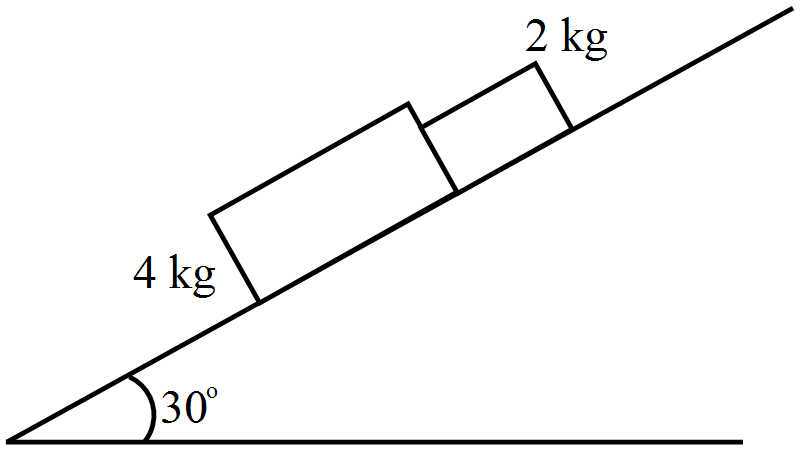
Figure shows two blocks in contact sliding down an inclined surface of inclination 30°. The friction coefficient between the block of mass 2.0kg and the incline is $\mu_1,$ and that between the block of mass 4.0kg and the incline is $\mu_2.$ Calculate the acceleration of the 2.0kg block if:
  1. $\mu_1=0.20$ and $\mu_2=0.30$
  2. $\mu_1=0.30$ and $\mu_2=0.20$ Take $\text{g}=10\text{m/s}^2.$
A tightly-wound solenoid of radius a and length l has n turns per unit length. It carries an electric current i. Consider a length dx of the solenoid at a distance x from one end. This contains n(dx) turns and may be approximated as a circular current in (dx).
  1. Write the magnetic field at the centre of the solenoid due to this circular current. Integrate this expression under proper limits to find the magnetic field at the centre of the solenoid.
  2. Verify that if a >> l, the field tends to $\text{B}=\frac{\mu_0\text{nil}}{2\text{a}}.$ Interpret these results.
Figure. shows two vessels A and B with rigid walls containing ideal gases. The pressure, temperature and the volume are $p_A, T_A, V$ in the vessel A and $p_B, T_B, V$ in the vessel B. The vessels are now connected through a small tube. Show that the pressure p and the temperature T satisfy $\frac{\text{p}}{\text{T}}=\frac{1}{2}\Big(\frac{\text{P}_\text{A}}{\text{T}_\text{A}}+\frac{\text{p}_\text{B}}{\text{T}_\text{B}}\Big)$ when equilibrium is achieved.
Electrons give up energy at the rate of $RI^2$ per second to the thermal energy. What time scale would one associate with energy in problem (a)? n = no of electron/volume $= 10^{29}/m^3,$ length of circuit = 10cm, cross-section $= A = (1mm)^2.$
