MCQ
$CrO_ 3$ dissolves in aqueous $NaOH$ to give
  • A
    $Cr_2O_7^{ - 2}$
  • $CrO_4^{ - 2}$
  • C
    $Cr(OH)_3$
  • D
    $Cr(OH)_2$

Answer

Correct option: B.
$CrO_4^{ - 2}$
b
$Cr{O_3} + {H_2}O \to {H_2}Cr{O_4}\xrightarrow{{2NaOH}}N{a_2}Cr{O_4} + 2{H_2}O$

Need a full question paper?

Generate a complete, print-ready paper with questions like this in minutes — across 16+ boards, with answer keys.

Start Generating Free

Similar questions

Elements with outer electronic configuration $n{s^2}n{p^6}$ are
The hydrogen bond is not present in
The correct decreasing order of energy, for the orbitals having, following set of quantum numbers.

$(A)$ $n=3,1=0, m=0$

$(B)$ $n=4,1=0, m=0$

$(C)$ $n =3,1=1, m =0$

$(D)$ $n=3,1=2, m=1$

In electroplating, the article to be electroplated serves as
A monoprotic acid in $ 1.00 \,M $ solution is $ 0.01\%$  ionised. The dissociation constant of this acid is
For the reaction in equilibrium ${N_2}{O_4}(g)\, \rightleftharpoons \,2N{O_2}(g)$ the equilibrium concentrations $N_2O_4$ and $NO_2$ are $4.8 \times 10^{-2}$ and $1.2 \times 10^{-2}\,mol/L,$ then $K_C$ is
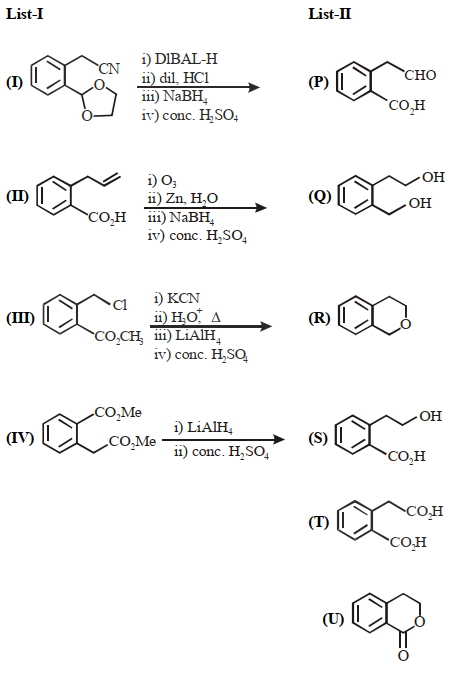
Answer the following by appropriately matching the lists based on the information given in the paragraph $List-I$ includess starting materials and reagents of selected chemical reactions. $List-II$ gives structures of compounds that may be formed as intermediate products and/or final products from the reactions of $List-I$

($1$) Which of the following options has correct combination considering $List-I$ and $List-II$?

$(1) (III), (S), (R)$ $(2) (IV), (Q), (R)$ $(3) (III), (T), (U)$ $(4) (IV), (Q), (U)$

($2$) Which of the following options has correct combination considering $List-I$ and $List-II$?

$(1) (I), (Q), (T), (U)$ $(2) (II), (P), (S), (U)$ $(3) (II), (P), (S), (T)$ $(4) (I), (S), (Q), (R)$

Give the answer quetion ($1$) and ($2$)
The formula of a gaseous hydrocarbon which requires $6$ times of its own volume of $O _{2}$ for complete oxidation and produces $4$ times its own volume of $CO _{2}$ is $C _{ x } H _{ y }$. The value of $y$ is ...... .
$Be ( OH )_2$ react with $Sr ( OH )_2$ to yield an ionic salt. Choose the incorrect option related to this reaction from the following:
All form ideal solution except