MCQ
Crystal field splitting energy for high spin $d^4$ octahedral complex is
  • A
    $- 1.2 \Delta _o$
  • $- 0.6 \Delta _o$
  • C
    $- 0.8 \Delta _o$
  • D
    $- 1.6 \Delta _o$

Answer

Correct option: B.
$- 0.6 \Delta _o$
b
in the case of high spin complex $\Delta_{0}$ is small. Thus, the energy required to pair up the fourth electron with the electrons of lower energy $d-$orbitals would be higher than that required to place the electrons in the higher $d-$orbital. Thus pairing does not occur.

For high spin $d^4$ octahedral complex,

therefore, Crystal field stabilisation energy

$=(-3 \times 0.4+1 \times 0.6) \Delta_{0}$

$=-(-1.2 \times 0.6) \Delta_{0}$

$=-0.6\Delta_{0}$

Need a full question paper?

Generate a complete, print-ready paper with questions like this in minutes — across 16+ boards, with answer keys.

Start Generating Free

Similar questions

Hybridization of central $I$ in $I_3^-$ that is
$5$ amperes is passed through a solution of zinc sulphate for $40 $ minutes. Find the amount of zinc deposited at the cathode ............. $\mathrm{gm}$
The adsorbent used in adsorption chromatography $1$s/are

$A$. silica gel  $B$. alumina  $C$. quick lime  $D$. magnesia

Choose the most appropriate answer from the options given below :
Bullet-proof steel alloy is prepared by using
Given below are two statements :
Statement (I) : A $\pi$ bonding MO has lower electron density above and below the inter-nuclear asix.
Statement (II) : The $\pi^*$ antibonding MO has a node between the nuclei.
In the light of the above statements, choose the most appropriate answer from the options given below:
A precipitate of $Ca{F_2}\,\,({K_{sp}} = 1.7 \times {10^{ - 10}})$ will be obtained when equal volume of the following are mixed
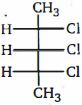
Number of diastereomer of given compound
The percentage of pyridine $(C_5H_5N)$ that forms pyridinium ion $(C_5H_5N^+H)$ in a $0.10\, M$ aqueous pyridine solution ($K_b$ for $C_5H_5N = 1.7 \times 10^{-9}$) is
The bond angles of $NH_3 , NH^+_4$ and $NH^-_2$ are in the order
$\begin{array}{*{20}{c}}
  {C{H_3} - C{H_2} - CH - C{H_3}\xrightarrow[{KOH}]{{Alc.}}\mathop X\limits_{\left( {{\text{major}}} \right)} \,;} \\ 
  {\,\,\,\,\,\,\,\,\,\,\,\,|\,\,\,\,\,\,\,\,\,\,\,\,\,\,\,\,\,\,\,\,\,\,\,\,\,\,\,\,\,\,\,} \\ 
  {\,\,\,\,\,\,\,\,\,\,\,\,\,Br\,\,\,\,\,\,\,\,\,\,\,\,\,\,\,\,\,\,\,\,\,\,\,\,\,\,\,\,\,} 
\end{array}\,$

$\begin{array}{*{20}{c}}
  {C{H_3} - C{H_2} - CH - C{H_3}\xrightarrow[\Delta ]{{EtoNa}}\mathop {{\text{ }}Y}\limits_{\left( {{\text{major}}} \right)} } \\ 
  {{\mkern 1mu} {\mkern 1mu} {\mkern 1mu} {\mkern 1mu} {\mkern 1mu} {\mkern 1mu} {\mkern 1mu} {\mkern 1mu} {\mkern 1mu} {\mkern 1mu} {\mkern 1mu} {\mkern 1mu} |{\mkern 1mu} {\mkern 1mu} {\mkern 1mu} {\mkern 1mu} {\mkern 1mu} {\mkern 1mu} \,\,\,\,\,{\mkern 1mu} \,\,\,\,{\mkern 1mu} {\mkern 1mu} {\mkern 1mu} {\mkern 1mu} {\mkern 1mu} {\mkern 1mu} {\mkern 1mu} {\mkern 1mu} {\mkern 1mu} {\mkern 1mu} {\mkern 1mu} {\mkern 1mu} {\mkern 1mu} {\mkern 1mu} {\mkern 1mu} {\mkern 1mu} {\mkern 1mu} {\mkern 1mu} {\mkern 1mu} {\mkern 1mu} {\mkern 1mu} {\mkern 1mu} {\mkern 1mu} {\mkern 1mu} } \\ 
  {{\mkern 1mu} {\mkern 1mu} {\mkern 1mu} \mathop {{\mkern 1mu} {\mkern 1mu} {\mkern 1mu} {\mkern 1mu} \,\,\,\,\,\,\,NM{e_3}\,\,\,\,\,\,\,{\mkern 1mu} }\limits_{\,\,\,\,\,\,\,\,\,\, \oplus \,\,\,\,\,\,\,\,\,\,\,\,\,\,\,\,\,\,\,\,} {\mkern 1mu} {\mkern 1mu} {\mkern 1mu} {\mkern 1mu} {\mkern 1mu} {\mkern 1mu} {\mkern 1mu} {\mkern 1mu} {\mkern 1mu} {\mkern 1mu} {\mkern 1mu} {\mkern 1mu} {\mkern 1mu} {\mkern 1mu} } 
\end{array}{\mkern 1mu} $

Product $(X)$ and $(Y)$ respectively is