MCQ
Curie temperature is the temperature above which:
- AA ferromagnetic material becomes paramagnetic.
- BA paramagnetic material becomes diamagnetic.
- CA ferromagnetic material becomes diamagnetic.
- DA paramagnetic material becomes ferromagnetic.
Explanation:
Curie Tempearture is the temperature at which certain materials lose their permanent magnetic properties, to be replaced by induced magnetism. In other words, it is the temperature above which a ferromagnetic material becomes paramagnetic.
Generate a complete, print-ready paper with questions like this in minutes — across 16+ boards, with answer keys.
When 2 amperes current is passed through a tangent galvanometer, it gives a deflection of 30o. For 60o deflection, the current must be
|
(a) 1 amp |
(b) 2 |
(c) 4 amp |
(d) 6 amp |
Assertion : Charge is invariant.
Reason : Charge does not depends on speed of frame of reference.
|
(a) If both assertion and reason are true and the reason is the correct explanation of the assertion. |
|
(b) If both assertion and reason are true but reason is not the correct explanation of the assertion. |
|
(c) If assertion is true but reason is false. |
|
(d) If the assertion and reason both are false. |
The maximum current that can be measured by a galvanometer of resistance 40 W is 10 mA. It is converted into a voltmeter that can read upto 50 V. The resistance to be connected in series with the galvanometer is ... (in ohm)
|
(a) 5040 |
(b) 4960 |
(c) 2010 |
(d) 4050 |
A 25 watt, 220 volt bulb and a 100 watt, 220 volt bulb are connected in parallel across a 220 volt line. Which bulb will glow more brightly
|
(a) 25 watt bulb |
(b) 100 watt bulb |
|
(c) Both will have same brightness |
(d) First 25 watt then 100 watt |
The absorption transitions between the first and the fourth energy states of hydrogen atom are 3. The emission transitions between these states will be
|
(a) 3 |
(b) 4 |
(c) 5 |
(d) 6 |
For the given combination of gates, if the logic states of inputs A, B, C are as follows A = B = C = 0 and A = B = 1, C = 0 then the logic states of output D are
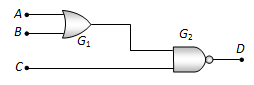
|
(a) 0, 0 |
(b) 0, 1 |
(c) 1, 0 |
(d) 1, 1 |
The number of turns in primary and secondary coils of a transformer are 100 and 20 respectively. If an alternating potential of 200 volt is applied to the primary, the induced potential in secondary will be
|
(a) 10 V |
(b) 40 V |
(c) 1000 V |
(d) 20,000 V |
