Question

Current provided by a battery is maximum when

(a) Internal resistance equal to external resistance

(b) Internal resistance is greater than external resistance

(c) Internal resistance is less than external resistance

(d) None of these

Answer

(a) Internal resistance equal to external resistance

Need a full question paper?

Generate a complete, print-ready paper with questions like this in minutes — across 16+ boards, with answer keys.

Start Generating Free

Similar questions

A hollow metallic sphere of radius R is given a charge Q. Then the potential at the centre is         

(a) Zero  

(b) . 

(c)

(d) .

An L-R circuit has a cell of e.m.f. E, which is switched on at time t = 0. The current in the circuit after a long time will be

(a) Zero

(b)  

(c)   

(d)  

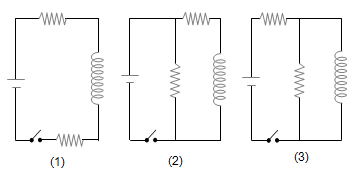
The figure shows three circuits with identical batteries, inductors, and resistors. Rank the circuits according to the current through the battery (i) just after the switch is closed and (ii) a long time later, greatest first

(a) (i)  (ii)  

(b) (i)   (ii)  

(c) (i)  (ii)  

(d) (i)  (ii)  

The relation between Ip and Vp for a triode is   , Keeping the grid potential constant at 1V, the value of rp will be

(a) 8 kW

(b) 4 kW

(c) 2 kW

(d) 8 kW

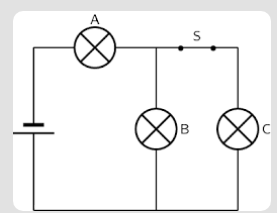
Which of the following is not a correct statement with respect to the given circuit?

The ratio of thermionic currents (I/I0) for a metal when the temperature is slowly increased  to T as shown in figure. (I and I0 are currents at T and respectively). Then which one is correct?

(a) A

(b) B

(c) C

(d) D

and  are point charges located at points as shown in the figure and S is a spherical Gaussian surface of radius R. Which of the following is true according to the Gauss’s law

(a)

(b)

(c)

(d) None of the above

Kinetic energy with the electrons are emitted from the metal surface due to photoelectric effect is:
Electric field lines cannot forms the:
Consider the following statements:
  1. An emf can be induced by moving a conductor in a magnetic field.
  2. An emf can be induced by changing the magnetic field.
  1. Both A and B are true.
  2. A is true but B is false.
  3. B is true but A is false.
  4. Both A and B are false.