MCQ
Cyclotron is used to accelerate
  • A
    Electrons
  • B
    Neutrons
  • Positive ions
  • D
    Negative ions

Answer

Correct option: C.
Positive ions
c
(c) A cylotron is a device by which the positively charged particles like proton, deuetron etc., can be acclearated. The working of cyclotron is bassed on the fact that a positively charged particle can be accelerated to a suffciently high energy with the help of similler values of oscilating electric field by making it to cross the same electric field time and again with the use of strong magentic field.

Need a full question paper?

Generate a complete, print-ready paper with questions like this in minutes — across 16+ boards, with answer keys.
Start Generating Free

Similar questions

A hollow metal sphere of radius $5\, cm$ is charged so that the potential on its surface is $10\, V$. The potential at the centre of the sphere is
Oxygen is $16$ times heavier than hydrogen. Equal volumes of hydrogen and oxygen are mixed. The ratio of speed of sound in the mixture to that in hydrogen is
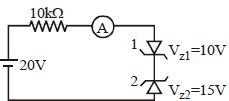
The reading of ammeter in the following circuit will be....$mA$
A particular star (assuming it as a black body) has a surface temperature of about $5 \times {10^4}K.$The wavelength in nanometers at which its radiation becomes maximum is $(b = 0.0029 mK)$
In order to shift a body of mass $m$ from a circular orbit of radius $3R$ to a higher radius $5R$ around the earth, the work done is
If a star is moving towards the earth, then the lines are shifted towards
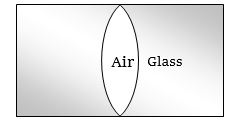
In the figure, an air lens of radii of curvature $10 cm$ (${R_1}$ = ${R_2}$ $= 10 cm$) is cut in a cylinder of glass $(\mu = 1.5)$. The focal length and the nature of the lens is
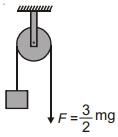
In the arrangement shown, the mass $m$ will ascend with an acceleration (Pulley and rope are massless)
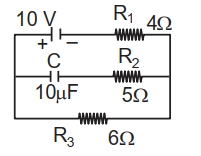
In an electrical circuit drawn below the amount of charge stored in the capacitor is___ $\mu \mathrm{C}$.
Two satellites $S_{1}$ and $S_{2}$ are revolving around a planet in the opposite sense in coplanar circular concentric orbits. At time $t=0$, the satellites are farthest apart. The periods of revolution of $S_{1}$ and $S_{2}$ are $3 \,h$ and $24 \,h$, respectively. The radius of the orbit of $S_{1}$ is $3 \times 10^{4} \,km$. Then, the orbital speed of $S_{2}$ as observed from