MCQ
${d \over {dx}}({e^{{x^3}}})$ is equal to
  • A
    $3x{e^{{x^3}}}$
  • $3{x^2}{e^{{x^3}}}$
  • C
    $3x{\left( {{e^{{x^3}}}} \right)^2}$
  • D
    $2{x^2}{e^{{x^3}}}$

Answer

Correct option: B.
$3{x^2}{e^{{x^3}}}$
b
(b) $\frac{d}{{dx}}({e^x}^3) = {e^x}^3.\frac{d}{{dx}}({x^3}) = 3{x^2}.\,{e^x}^3$.

Need a full question paper?

Generate a complete, print-ready paper with questions like this in minutes — across 16+ boards, with answer keys.

Start Generating Free

Similar questions

Let $\omega$ be a complex cube root of unity with $\omega \neq 1$ and $P=\left[p_j\right]$ be a $n \times n$ matrix with $p_{i j}=\omega^{i+j}$. Then $P ^2 \neq 0$, when $n =$

$(A)$ $57$ $(B)$ $55$ $(C)$ $58$ $(D)$ $56$
The orthogonal projection of $\vec{\text{a}}$ on $\vec{\text{b}}$ is:
Let $a,\,\,b$ and $c$ be non-zero vectors such that $(a \times b) \times c = \frac{1}{3}|b||c|a.$ If $\theta$ is the acute angle between the vectors $b$ and $c$, then $\sin \theta $ equals
Which of the following function $(s)$ is/are Transcidental?
If $\left(a_1, b_1, c_1\right)$ and $\left(a_2, b_2, c_2\right)$ be the direction ratios of two parallel lines then
Consider the curves $\text{y}=\sin\text{x}$ and $\text{y}=\cos\text{x}.$ What is the area of the region bounded by the above two curves and the lines $\text{x}=0$ and $\text{x}=\frac{\pi}{4}?$
Evaluate: $\int \frac{\left(x^4-x\right)^{\frac{1}{4}}}{x^5} d x$
If $\tan \mathrm{A}=\frac{1}{\sqrt{x\left(x^2+x+1\right)}}, \tan B=\frac{\sqrt{x}}{\sqrt{x^2+x+1}}$ and $\tan C=\left(x^{-3}+x^{-2}+x^{-1}\right)^{\frac{1}{2}}, 0 < A, B, C < \frac{\pi}{2}$ then $A+B$ is equal to :
The slope of tangent at any point $(x, y)$ on a curve $y = y ( x )$ is $\frac{x^2+y^2}{2 x y},x > 0$. If $y(2)=0$, then a value of $y(8)$ is
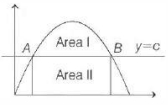
The figure shows a portion of the graph $y=2 x-4 x^3$.The line $y=c$ is such that the areas of the regions marked $I$ and $II$ are equal. If $a, b$ are the $x$-coordinates of $A, B$ respectively, then $a+b$ equals