MCQ
${d \over {dx}}{\left( {\sqrt x + {1 \over {\sqrt x }}} \right)^2} = $
  • $1 - {1 \over {{x^2}}}$
  • B
    $1 + {1 \over {{x^2}}}$
  • C
    $1 - {1 \over {2x}}$
  • D
    None of these

Answer

Correct option: A.
$1 - {1 \over {{x^2}}}$
a
(a) $\frac{d}{{dx}}{\left( {\sqrt x + \frac{1}{{\sqrt x }}} \right)^2} = \frac{d}{{dx}}\left[ {x + \frac{1}{x} + 1} \right] = 1 - \frac{1}{{{x^2}}}$.

Need a full question paper?

Generate a complete, print-ready paper with questions like this in minutes — across 16+ boards, with answer keys.
Start Generating Free

Similar questions

Minimize $z=\sum_{j=1}^n \sum_{i=1}^m c_{i j} x_{i j}$, subject to
$
\sum_{j=1}^n x_{i j}=a_i, i=1,2, \ldots, m \text { and } \sum_{i=1}^m x_{i j}=b_j, j=1,2, \ldots, n
$
is an L.P.P. with number of constraints
The area bounded by the curve $\text{y}=\cos\text{x}$ in one are of the curve is where $=4\text{n}+1,\text{x}\in \text{integer} :$
The value of the integral $\int {\frac{{\sin \,\left( {\ln \,(2 + 2x)} \right)}}{{x + 1}}dx} $ is
Let  $f(x) =\left| {\begin{array}{*{20}{c}}
{\cos \,x}&{\sin \,x}&{\cos \,x}\\
{\cos \,2x}&{\sin \,2x}&{2\,\cos \,2x}\\
{\cos \,3x}&{\sin \,3x}&{3\,\cos \,3x}
\end{array}} \right| $then $f ' \left( {\frac{\pi }{2}} \right)$=
It is given that $X\left[\begin{array}{cc}3 & 2 \\ 1 & -1\end{array}\right]=\left[\begin{array}{ll}4 & 1 \\ 2 & 3\end{array}\right]$. Then matrix $X$ is :
The value of p and q for which the function $f ( x )=\left\{\begin{array}{ll}\frac{\sin (p+1) x+\sin x}{x} & , x<0 \\ q & , x=0 \\ \frac{\sqrt{x+b x^2}-\sqrt{x}}{x^{\frac{3}{2}}} & , x>0\end{array}\right.$ is continuous for all $x \in R$, are
Number of real values of $\lambda$ for which the matrix $A =$ $\left[ {\begin{array}{*{20}{c}}{\lambda  - 1}&\lambda &{\lambda  + 1}\\2&{ - 1}&3\\ {\lambda  + 3}&{\lambda  - 2}&{\lambda  + 7}\end{array}} \right]$ has no inverse
Let ${I_n} = \smallint {\tan ^n}xdx,\left( {n > 1} \right).$   ${I_4} + {I_6} = a{\tan ^5}x + b{x^5} + C$, where $C$ is constant of integration , then ordered pair $\left( {a,b} \right)$ equal to :
$\int_0^\pi x \,f\,(\sin x)\,dx = $
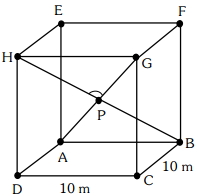
A hall has a square floor of dimension $10\, \mathrm{~m} \times 10\, \mathrm{~m}$ (see the figure) and vertical walls. If the angle $GPH$ between the diagonals $\mathrm{AG}$ and $\mathrm{BH}$ is $\cos ^{-1} \frac{1}{5}$, then the height of the hall (in $meters$) is :