MCQ
${d \over {dx}}\sqrt {{{1 + \cos 2x} \over {1 - \cos 2x}}} = $
  • A
    ${\sec ^2}x$
  • $ - {\rm{cose}}{{\rm{c}}^2}x$
  • C
    $2\,{\sec ^2}{x \over 2}$
  • D
    $ - 2{\rm{cose}}{{\rm{c}}^2}{x \over 2}$

Answer

Correct option: B.
$ - {\rm{cose}}{{\rm{c}}^2}x$
b
(b) $\frac{d}{{dx}}\sqrt {\frac{{1 + \cos 2x}}{{1 - \cos 2x}}} = \frac{d}{{dx}}\cot x = - {\rm{cose}}{{\rm{c}}^2}x$.

Need a full question paper?

Generate a complete, print-ready paper with questions like this in minutes — across 16+ boards, with answer keys.
Start Generating Free

Similar questions

$\int {\frac{{\log x -log^2\ x+ x^2}}{{{x^3}}}} dx\,\,is\, $         (where $C$ is constant of integration)
Let $\alpha, \beta$ be the roots of the equation $x^{2}-4 \lambda x+5=0$ and $\alpha, \gamma$ be the roots of the equation $x^{2}-(3 \sqrt{2}+2 \sqrt{3}) x+7+3 \lambda \sqrt{3}=0$. If $\beta+\gamma=3 \sqrt{2}$, then $(\alpha+2 \beta+\gamma)^{2}$ is equal to
Let $A=\{1,3,4,6,9\}$ and $B=\{2,4,5,8,10\}$. Let $R$ be a relation defined on $A \times B$ such that $R =$ $\left\{\left(\left(a_1, b_1\right),\left(a_2, b_2\right)\right): a_1 \leq b_2\right.$ and $\left.b_1 \leq a_2\right\}$. Then the number of elements in the set $R$ is
The value of $\int\limits_0^{{{\sin }^2}x} {{{\sin }^{ - 1}}\sqrt t \,dt}  + \int\limits_0^{{{\cos }^2}x} {{{\cos }^{ - 1}}\sqrt t \,dt} $ in $(0, \pi/2)$ is-
The equation of the line bisecting the line segment joining the points $(a, b)$ and $(a',\;b')$ at right angle, is
A unit vector perpendicular to vector  $  c $ and coplanar with vectors  $a$  and $b$ is
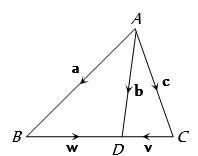
In the figure, a vector $x$  satisfies the equation $x - w = v$. Then $x =$
The value of $6({\sin ^6}\theta + {\cos ^6}\theta ) - 9({\sin ^4}\theta + {\cos ^4}\theta ) + 4$ is
The equation of circle described on the chord $3x + y+ 5\, = 0$ of the circle $x^2 + y^2\, = 16$ as diameter is
Let a line pass through two distinct points $P(-2,-1,3)$ and $Q$, and be parallel to the vector $3 \hat{i}+2 \hat{j}+2 k$. If the distance of the point $Q$ from the point $R (1,3,3)$ is 5 , then the square of the area of $\triangle PQR$ is equal to: