MCQ
${d \over {dx}}{\tan ^{ - 1}}\left[ {{{3{a^2}x - {x^3}} \over {a({a^2} - 3{x^2})}}} \right]$ at $x = 0$ is
  • A
    ${1 \over a}$
  • ${3 \over a}$
  • C
    $3a$
  • D
    $3$

Answer

Correct option: B.
${3 \over a}$
b
(b) $\frac{d}{{dx}}{\tan ^{ - 1}}\left[ {\frac{{3{a^2}x - {x^3}}}{{a({a^2} - 3{x^2})}}} \right]$

Put $x = a\tan \theta $ 

$ \Rightarrow \frac{d}{{dx}}{\tan ^{ - 1}}\left[ {\frac{{3{a^3}\tan \theta - {a^3}{{\tan }^3}\theta }}{{{a^3} - 3{a^3}{{\tan }^2}\theta }}} \right]$

$ = \frac{d}{{dx}}{\tan ^{ - 1}}(\tan 3\theta ) = \frac{d}{{dx}}(3\theta ) = \frac{{3a}}{{{x^2} + {a^2}}}$

If $x = 0,$  then  $\frac{d}{{dx}}{\tan ^{ - 1}}\left[ {\frac{{3{a^2}x - {x^3}}}{{a({a^2} - 3{x^2})}}} \right] = \frac{3}{a}$.

Need a full question paper?

Generate a complete, print-ready paper with questions like this in minutes — across 16+ boards, with answer keys.
Start Generating Free

Similar questions

The points $(3, 2, 0), (5, 3, 2)$ and $(-9, 6, -3)$, are the vertices of a triangle $ABC$. $AD$ is the internal bisector of $\angle BAC$ which meets $BC$ at $D$, then the co-ordinates of $D$, are
If $\log _{10} 2, \log _{10} (2^x + 1), \log _{10} (2^x + 3)$ are in $A.P.,$ then :-
Let $S=\{z=x+i y:|z-1+i| \geq|z|,|z|<2,|z+i|=$ $|z-1|\}$. Then the set of all values of $x$, for which $w=2 x+i y \in S$ for some $y \in R$, is.
If the non-zero vectors $ a $ and $b$  are perpendicular to each other, then the solution of the equation $r \times a = b$ is given by
A bag has $13$ red, $14$ green and $15$ black balls. The probability of getting exactly $2$ blacks on pulling out $4$ balls is ${P_1}$. Now the number of each colour ball is doubled and $8$ balls are pulled out. The probability of getting exactly $4$ blacks is ${P_2}.$ Then
If $f(x)$ satisfies $f(7 -x) = f(7 + x)\ \forall \,x\, \in \,R$ such that $f(x)$ has exactly $5$ real roots which are all distinct such that sum of the real roots is $S$ then $S/7$ is equal to
Six boys and six girls sit in a row. What is the probability that the boys and girls sit alternatively
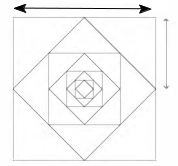
Let $S_1$ be the sum of areas of the squares whose sides are parallel to coordinate axes. Let $S_2$ be the sum of areas of the slanted squares as shown in the figure. Then, $\frac{S_1}{S_2}$ is equal to
The sum to infinity of the following series $\frac{1}{{1.2}} + \frac{1}{{2.3}} + \frac{1}{{3.4}} + ...........$ shall be
The equation of motion of a stone thrown vertically upward from the surface of a planet is given by $s = 10\,\,t - 3{t^2}$, and the units of $s$ and $t$ are $cm$ and $sec$ respectively. The stone will return to the surface of the planet after