MCQ
Davission and Germer experiment proved
  • A
    Wave nature of light
  • B
    Particle nature of light
  • C
    Both $(a)$ and $(b)$
  • Neither $(a)$ nor $(b)$

Answer

Correct option: D.
Neither $(a)$ nor $(b)$
d
(d) Davission and Germer proved the wave nature of electron by performing an experiment.

Need a full question paper?

Generate a complete, print-ready paper with questions like this in minutes — across 16+ boards, with answer keys.
Start Generating Free

Similar questions

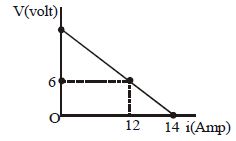
$10\, Cells$, each of $emf$ $'E'$ and internal resistance $'r'$, are connected in series to a variable external resistance. Figure shows the variation of terminal potential difference of their combination with the current drawn from the combination.$Emf$ of each cell is ................ $V$
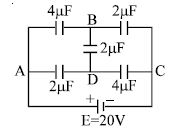
The figure shows a diagonal symmetric arrangement of capacitors and a battery. If the potential of $C$ is zero, then
The frequency and the intensity of a beam of light falling on the surface of photoelectric material are increased by a factor of two. This will :
Which of the following is a necessary and sufficient condition for S.H.M.
In Young's double slit experiment, the distance between the two slits is $0.1 \,mm$, the distance between the slits and the screen is $1 \,m$ and the wavelength of the light used is $600 \,nm$. The intensity at a point on the screen is $75 \%$ of the maximum intensity. smallest distance ................ $\,mm$ of this point from the central fringe
The maximum value attained by the tension in the string of a swinging pendulum is four times the minimum value it attains. There is no slack in the string. The angular amplitude of the pendulum is
The ratio of secondary to the primary turns in a transformer is $3 : 2$. If the power output be $P$, then the input power neglecting all loses must be equal to
The equation of motion of a particle is $\frac{{{d^2}y}}{{d{t^2}}} + Ky = 0$, where $K$ is positive constant. The time period of the motion is given by
A car turns a corner on a slippery road at a constant speed of $10\,m/s$. If the coefficient of friction is $0.5$, the minimum radius of the arc in meter in which the car turns is
A man suffering from short sight is unable to see objects distinctly at a distance greater than $2\,m.$ The power of lens required to correct this defect should be.......$D$