MCQ
de-Broglie equation is
  • A
    $n\lambda = 2d\sin \theta $
  • B
    $E = hv$
  • C
    $E = m{c^2}$
  • $\lambda = \frac{h}{{mv}}$

Answer

Correct option: D.
$\lambda = \frac{h}{{mv}}$
d
(d) According to de-Broglie $\left( {\lambda = \frac{h}{{mv}}} \right)$.

Need a full question paper?

Generate a complete, print-ready paper with questions like this in minutes — across 16+ boards, with answer keys.
Start Generating Free

Similar questions

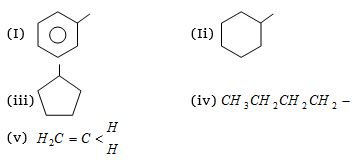
Examine the following common chemical structures to which simple functional groups are often attached Which of these systems have essentially planar geometry
The effect of lanthanoid contraction in the lanthanoid series of elements by the large means
An alkene given two moles of $HCHO$, one mole of $C{O_2}$ and one mole of $C{H_3}COCHO$on ozonolysis. What is its structure 
One would expect proton to have very large
Which of the following statements is incorrect ?
The state of hybridisation of central atom in dimer of $BH_3$ and $BeH_2$ is
Which of the following is not a consequence of the Lanthanoid contraction?
Which of the following halogen acids is least acidic
$C{H_3} - CH = CH - CH(OH) - C{H_3}\mathop {\xrightarrow{{{\text{Jon's}}}}}\limits_{{\text{reagent}}} $  $X$,

Product  $ X$ is

$2.5 \mathrm{~g}$ of a non-volatile, non-electrolyte is dissolved in $100 \mathrm{~g}$ of water at $25^{\circ} \mathrm{C}$. The solution showed a boiling point elevation by $2^{\circ} \mathrm{C}$. Assuming the solute concentration in negligible with respect to the solvent concentration, the vapour pressure of the resulting aqueous solution is . . . . . .  $\mathrm{mm}$ of $\mathrm{Hg}$ (nearest integer)

[Given : Molal boiling point elevation constant of water $\left(\mathrm{K}_{\mathrm{b}}\right)=0.52 \mathrm{K.} \mathrm{kg} \mathrm{mol}^{-1}$,

$1 \mathrm{~atm}$ pressure $=760 \mathrm{~mm}$ of $\mathrm{Hg}$, molar mass of water $\left.=18 \mathrm{~g} \mathrm{~mol}^{-1}\right\rfloor$