MCQ
de Broglie relation is true for:
- AAll particles
- BCharged particles only
- CNegatively charged particles only
- DMassless particles like photons only
Explanation:
For any particle of mass m moving with velocity v has a de Broglie wavelength given by:
$\gamma=\frac{\text{h}}{\text{p}}$ This is true for all material particle.
Generate a complete, print-ready paper with questions like this in minutes — across 16+ boards, with answer keys.
The frequency of light ray having the wavelength 3000 Å is
|
(a) 9 × 10¹³ cycles/sec |
(b) 1015 cycles/sec |
(c) 90 cycles/sec |
(d) 3000 cycles/sec |
Which of the following is not a mode of radioactive decay
|
(a) Positron emission |
(b) Electron capture |
(c) Fusion |
(d) Alpha decay |
The electric flux for Gaussian surface A that enclose the charged particles in free space is (given q1 = –14 nC, q2 = 78.85 nC, q3 = – 56 nC)
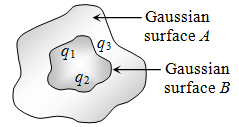
|
(a) 103 Nm2 C–1 |
(b) 103 CN-1 m–2 |
(c) 6.32 × 10³ Nm2 C–1 |
(d) 6.32 × 10³ CN-1 m–2 |
Surface temperature of the sun is of the order of
|
(a) 5000 K |
(b) 7000 K |
(c) 6000 K |
(d) 12000 K |
In a diode valve the cathode temperature must be (f = work function)
|
(a) High and ∅ should be high |
(b) High and ∅ should be low |
|
(c) Low and ∅ should be high |
(d) Low and ∅ should be high |
Electrical conductivity of a semiconductor
|
(a) Decreases with the rise in its temperature |
|
(b) Increases with the rise in its temperature |
|
(c) Does not change with the rise in its temperature |
|
(d) First increases and then decreases with the rise in its temperature |
The mobility of free electron is greater than that of free holes because
|
(a) The carry negative charge |
|
(b) They are light |
|
(c) They mutually collide less |
|
(d) They require low energy to continue their motion |