MCQ
de Broglie relation is true for:
  • All particles
  • B
    Charged particles only
  • C
    Negatively charged particles only
  • D
    Massless particles like photons only

Answer

Correct option: A.
All particles

For any particle of mass m moving with velocity $v$ has a de Broglie wavelength given by:
$\gamma=\frac{\text{h}}{\text{p}}$ This is true for all material particle.

Need a full question paper?

Generate a complete, print-ready paper with questions like this in minutes — across 16+ boards, with answer keys.
Start Generating Free

Similar questions

Which of the following is quantised according to Bohr’s theory of hydrogen atom
A charge ${q_1}$ exerts some force on a second charge ${q_2}$. If third charge ${q_3}$ is brought near, the force of ${q_1}$ exerted on ${q_2}$
A pellet carrying charge of 0.5 coulombs is accelerated through a potential of 2,000 volts. It attains a kinetic energy equal to
When a test charge is brought from infinity to near the dipole along the neutral line of an electric dipole, then the work done will be:
The layered lens is made of two kinds of glass. A point source of light is placed on its principal axis. If the reflections from the boundaries between layers are ignored, the lens will form
Two pure inductors each of self inductance L are connected in parallel but are well separated from each other. The total inductance is
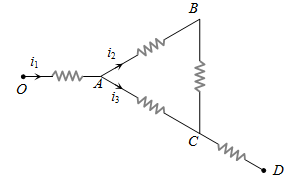
The current in the arm CD of the circuit will be

The muon has the same charge as an electron but a mass that is $207$ times greater. The negatively charged muon can bind to a proton to form a new type of hydrogen atom. How does the binding energy $E_{Bμ}$ of the muon in the ground state of a muonic hydrogen atom  compare with the binding energy $E_{Be}$ of an electron in the ground state of a conventional hydrogen atom ?
A radioactive substance has a half life of 60 minutes. After 3 hours, the fraction of atom that have decayed would be
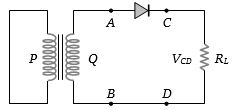
In the half-wave rectifier circuit shown. Which one of the following wave forms is true for ${V_{CD}}$, the output across $C$ and $D$?