Question
de Broglie wavelength associated with an electron accelerated through a potential difference V is $\lambda$ What will be the de Broglie wavelength when the accelerating potential is increased to 4V?

Answer

$\frac{\gamma}{2}$

Reason: de Broglie wavelength associated with electron is,

$\lambda=\frac{\text{h}}{\sqrt{2\text{meV}}}\Rightarrow\ \lambda\propto\frac{1}{\sqrt{\text{V}}}$

Obviously when accelerating potential becomes 4V, the de-Broglie wavelength reduces to half.

Need a full question paper?

Generate a complete, print-ready paper with questions like this in minutes — across 16+ boards, with answer keys.
Start Generating Free

Similar questions

If the total mechanical energy of a particle is zero, is its linear momentum necessarily zero? Is it necessarily non-zero?
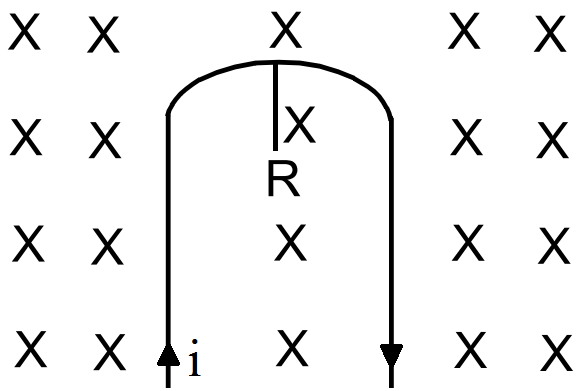
A rigid wire consists of a semi-circular portion of radius R and two straight sections The wire is partially immersed in a perpendicular magnetic field B, as shown in the figure. Find the magnetic force on the wire if it carries a current i.

Define resolving power of a compound microscope. How does the resolving power of a compound microscope change when.
  1. refractive index of the medium between the object and objective lens increases?
  2. wavelength of the radiation used is increased?
A point charge ' $q$ ' is placed at point $O$ as shown in the figure. Will $\left(V_A-V_B\right)$ be positive, negative or zero if $q$ is (i) positive (ii) negative.
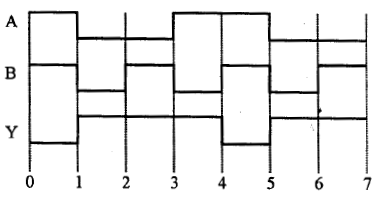
The following figure shows the input waveforms (A, ,B) and the output waveform (Y) of a gate. Identify the gate, write its truth table and draw its logic symbol.

A coil of N turns is wound tightly in the form of a spiral whose internal and external radii $r_1$ are $r_2$ and respectively. Current $I$ is flowing through the coil, then calculate the magnetic field at the center.
What is diffraction? Which are the factors on which diffraction depends ? Give some examples of day to day life where the diffraction phenomenon is observed.
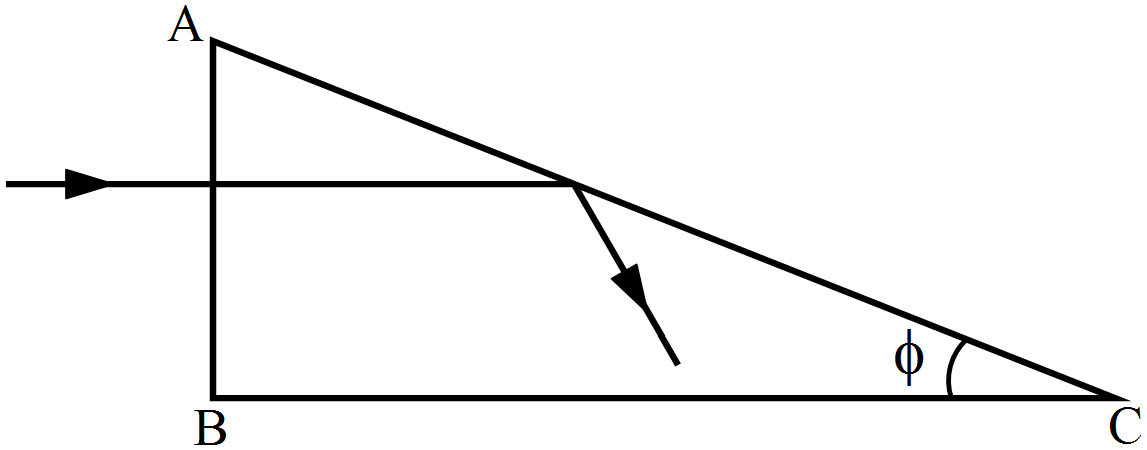
 A light ray is incident normally on the face AB of a right-angled prism ABC $(\mu=1.50)$ as shown in figure. What is the largest angle $\phi$ for which the light ray is totally reflected at the surface AC? 

When an electron falls from a higher energy to a lower energy level, the difference in the energies appears in the form of electromagnetic radiation. Why cannot it be emitted as other forms of energy?
Equipotential surfaces are 5 cm apart from each other. How much work will be required to move a 500 µC charge between distant points?