MCQ
de-Broglie wavelength is :
  • A
    $ \lambda=hmv $
  • $ \lambda=\frac{h}{mv} $
  • C
    $ \lambda=\frac{mc^{2}}{v} $
  • D
    $ \lambda=hv $

Answer

Correct option: B.
$ \lambda=\frac{h}{mv} $
B

Need a full question paper?

Generate a complete, print-ready paper with questions like this in minutes — across 16+ boards, with answer keys.

Start Generating Free

Similar questions

Three capacitors whose capacitances are 2,4 and $\chi_\mu F$ respectively. They are combine first in series and then in parallel. In both the cases the ratio of their equivalents will be :
A solenoid of inductance L carrying a certain current is linked with a total magnetic flux $\phi$. Now it is connected to a condenser with which it shares half of its initial energy. The total flux now linked with the solenoid is:
The wiring of a house has resistance 6Ω A 100 W bulb is glowing. If a geyser of 1000 W is switched on, the change in potential drop across the bulb is nearly (a) Nil(b) 23 V(c) 32 V   (d) 12 V
       
The use of study of hysteresis curve for a given material is to estimate the(a) Voltage loss(b) Hysteresis loss(c) Current loss(d) All of these
       
In a large building, there are 15 bulbs of 40W, 5 bulbs of 100W, 5 fans of 80W and 1 heater of 1kW. The voltage of electric mains is 220V. The minimum capacity of the main fuse of the building will be:
Two particle of equal mass $m$ and charge $q$ are placed at a distance of $16 \ cm$. They do not experience any force. The value of $\frac{q}{m}$ is 
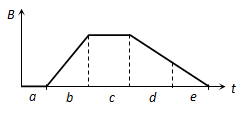
The graph gives the magnitude $B(t)$ of a uniform magnetic field that exists throughout a conducting loop, perpendicular to the plane of the loop. Rank the five regions of the graph according to the magnitude of the emf induced in the loop, greatest first
An experiment to verify ohm's law, a conductor of resistance R is taken. During the experiment, temperature of the conductor increases with the flow of current. Resistance of the conductor will:
A very thin film in reflected white light appears:
The work function of a metal is $ hc/\lambda_{0} $. Light of wavelength $ \lambda $ is incident on the surface of the metal. For emission of electrons from the metal the condition is :