Question
Decide the unit for specific heat capacity.

Answer

1. The amount of heat $(Q)$ required to change the temperature of a substance is directly proportional to:
a. the mass of the substance $( m )$.
b. change in temperature of the substance $(\Delta T)$.
$\therefore Q \propto m$ and $Q \propto \Delta T$
$\therefore Q \propto m \Delta T$
$\therefore Q = cm \Delta T$
where ' $c$ ' is specific heat or specific heat capacity of a substance. From equation (1),
$
c=\frac{ Q }{ m \Delta T }
$
2. SI unit:
As $SI$ unit of heat is J, mass is $kg$ and change in temperature is ${ }^{\circ} C$, SI unit of specific heat capacity is $J / kg { }^{\circ} C$
3. C.G.S. unit:
As CGS unit of heat is calorie, mass is $g$ and change in temperature is ${ }^{\circ} C , CGS$ unit of specific heat capacity is cal $/ g ^{\circ} C$

Need a full question paper?

Generate a complete, print-ready paper with questions like this in minutes — across 16+ boards, with answer keys.
Start Generating Free

Similar questions

Write short notes: Embryology.
The gravitational pull of the moon cause the sea-water to rise periodically.
  1. What name is given to the condition of the sea when water to rise periodically.
  2. What name is given to the condition of the sea when its raised water recedes?
  3. What name is given to the energy which can be harnessed from this natural phenomenon?
  4. Draw labelled diagram to show how this energy can be harnessed from this natural.
A metal X forms a water soluble salt $XNO_3$. When an aqueous solution of $XNO_3$​​​​​​​ is added to common salt solution, then a white precipitate of compound Y is formed alongwith sodium nitrate solution. Metal X is said to be the best conductor of electricity and it does not evolve hydrogen when put in dilute hydrohloric acid.
  1. What is metal $X$?
  2. What is salt $XNO_3$​​​​​​​?
  3. Name the compound Y.
  4. Write the chemical equation of the reaction which takes place on reacting $XNO_3​​​​​​​$​​​​​​​solution and common salt solution giving the physical states of all the reactants and products.
  5. What type of chemical reaction is illustrated by the above equation?
Write short notes :
Hope's apparatus
How can the oil spills of rivers and oceans be cleaned?
Write short notes: Chipko Movement of Bishnoi.
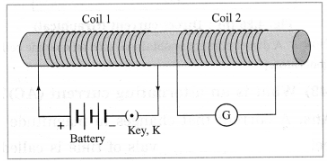
Take two coils of about 50 turns. Insert them over a nonconducting cylindrical roll as shown in Figure.
Image

(A thick paper roll can be used.) Connect coil 1 to a battery with a plug key K. Connect coil 2 to a galvanometer G. (1) Plug the key and observe the deflection in the galvanometer. (2) Unplug the key and again observe the deflection.
Note your observations. What conclusions do you draw from these observations?

A unicellular animal P having no fixed shape ingests a food particle by forming temporary finger-like projections Q. The food particle is engulfed with a little surrounding water to form a temporary stomach R inside it. The chemicals S from surrounding cytoplasm enter into R and break down food into small and soluble molecules by chemical reactions. The digested food is absorbed directly into cytoplasm by the process T. The undigested food is thrown out of the body by the rupture of a cell organelle U in a process called V.
  1. Name the unicellular animal P.
  2. What are (i) Q, and (ii) R?
  3. Name (i) chemical S, and (ii) process T.
  4. Name (i) organelle U, and (ii) process V.
TypeCharacterExamples
Cyclostomata…………………………
……………Gill respiration……………
Amphibia…………………………
…………………………Whale, Cat, Man
……………Poikilotherms……………
Explain the similarity and difference in two events, namely adding $NaOH$ to water and adding $CaO$ to water.