Question
Define a magnet and write its characteristics of directive property and pole strength.

Answer

Such a substance which attracts other magnetic substances such as iron etc. towards itself and when it is suspended freely, then it rests in north-south direction. Its two and equal opposite poles are separated by some distance.
Directive property : When any bar magnet is suspended freely, it always rests in a definite direction. Its one end is towards the north and the other is towards the south which are known as north pole and south pole respectively. A bar magnet always exhibits north and south direction.
Pole strength : Strength of magnetisation of magnetic poles is known as pole strength. Pole strength of both poles of a bar magnet is same. If a bar magnet is cut perpendicular to its axis, then pole strength of poles of each part will almost be same as of original magnet and if it is cut in to equal parts along its axis, then pole strength of each part will be half that of original bar magnet.
Need a full question paper?

Generate a complete, print-ready paper with questions like this in minutes — across 16+ boards, with answer keys.

Start Generating Free

Similar questions

Write first rule of Kirchhoff (junction rule).By drawing circuit diagram of Wheatstone Bridge, obtain condition for zero deflection in the bridge.
Do all the thermocouples have a neutral temperature?
The ends of a metre stick a.re maintained at $100^\circ C$ and $0^\circ C.$ One end of a rod is maintained at $25^\circ C.$ Where should its other end be touched on the metre stick so that there is no heat current in the rod in steady state?
Why is the mass of a nucleus always less than the sum of the masses of its constituents, neutrons and protons?If the total number of neutrons and protons in a nuclear reaction is conserved, how then is the energy absorbed or evolved in the reaction? Explain.
Explain how resistance of conductor depends on the dimension of the conductor and derive its equation.
A circular loop of radius r carrying a current i is held at the centre of another circular loop of radius R(>> r) carrying a current I. The plane of the smaller loop makes an angle of 30° with that of the larger loop. If the smaller loop is held fixed in this position by applying a single force at a point on its periphery, what would be the minimum magnitude of this force?
A liquid$-$nitrogen container is made of a $1\ cm$ thick styrofoam sheet having thermal conductivity $0.025\text{Js}^{-1}\text{m}^{-1}{^\circ}\text{C}^{-1}.$ Liquid nitrogen at $80K$ is kept in it. A total area of $0.80m^2$ is in contact with the liquid nitrogen. The atmospheric temperature is $300K.$ Calculate the rate of heat flow from the atmosphere to the liquid nitrogen.
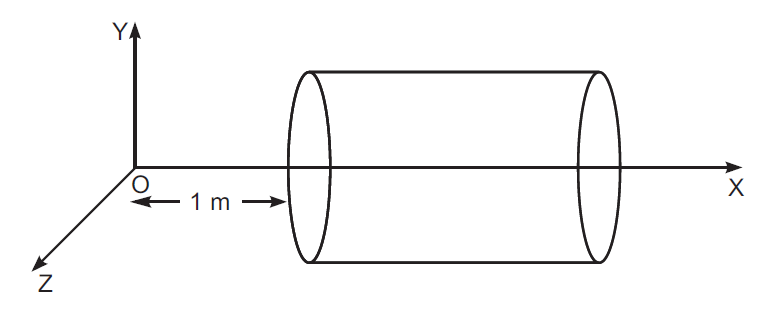
A hollow cylindrical box of length $1 m$ and area of cross$-$section $25 \ cm^2$ is placed in a three dimensional coordinate system as shown in the figure. The electric field in the region is given by$\overrightarrow{\text{E}} = 50\text{x}\hat{\text{i}},$ where $E$ is in $NC^{–1}$ and $x$ is in metres. Find
  1. Net flux through the cylinder.
  2. Charge enclosed by the cylinder.
Suppose that the particle in Exercise in $1.33$ is an electron projected with velocity $v_x= 2.0 \times 10^6 m s^{–1}.$ If $E$ between the plates separated by $0.5 \ cm$ is $9.1 \times 10^2N/C,$ where will the electron strike the upper plate? $(|e|=1.6 \times 10^{–19}C, m_e = 9.1 \times 10^{–31} \ kg.)$
A long, straight wire of radius r carries a current i and is placed horizontally in a uniform magnetic field B pointing vertically upward. The current is uniformly distributed over its cross-section.
  1. At what points will the resultant magnetic field have maximum magnitude? What will be the maximum magnitude?
  2. What will be the minimum magnitude of the resultant magnetic field?