Question
Define a Trial Balance. Why is it prepared?

Answer

''A Trial Balance is a statement, prepared with the debit and credit balances of the Ledger Accounts to test the arithmetical accuracy of the books.'' -J.R. Batliboi ''A Trial Balance is the list of debit and credit balances, taken out from the Ledger. It also includes the balances of cash and bank taken from the Cash Book.'' -CarterPurpose of a Trial Balance:
  1. Trial Balance acts as the first step in the preparation of financial statements. It is a working paper that accountants use as a basis while preparing financial statements.
  2. Trial balance ensures that for every debit entry recorded, a corresponding credit entry has been recorded in the books in accordance with the double entry concept of accounting. If the totals of the trial balance do not agree, the differences may be investigated and resolved before financial statements are prepared. Rectifying basic accounting errors can be a much lengthy task after the financial statements have been prepared because of the changes that would be required to correct the financial statements.
  3. Trial balance ensures that the account balances are accurately extracted from accounting ledgers.
  4. Trail balance assists in the identification and rectification of errors.

Need a full question paper?

Generate a complete, print-ready paper with questions like this in minutes — across 16+ boards, with answer keys.

Start Generating Free

Similar questions

Prepare Accounting Equation from the following:
  1. Started business with Cash ₹ 2,00,000.
  2. Purchased goods for Cash ₹ 60,000 and on Credit ₹ 1,50,000.
  3. Sold goods for Cash costing ₹ 40,000 at a profit of 20% and on Credit costing ₹ 72,000 at a profit of 25%.
  4. Paid for Rent ₹ 5,000.
Journalise the following transactions:
2019
 
March 5
Sold goods to Shruti for ₹ 80,000 at 15% trade discount and 4% cash discount. Received 75% amount immediately through a cheque.
March 10
Purchased goods from Richa for ₹ 60,000 at 10% trade discount and 5% cash discount. 60% amount paid by cheque immediately.
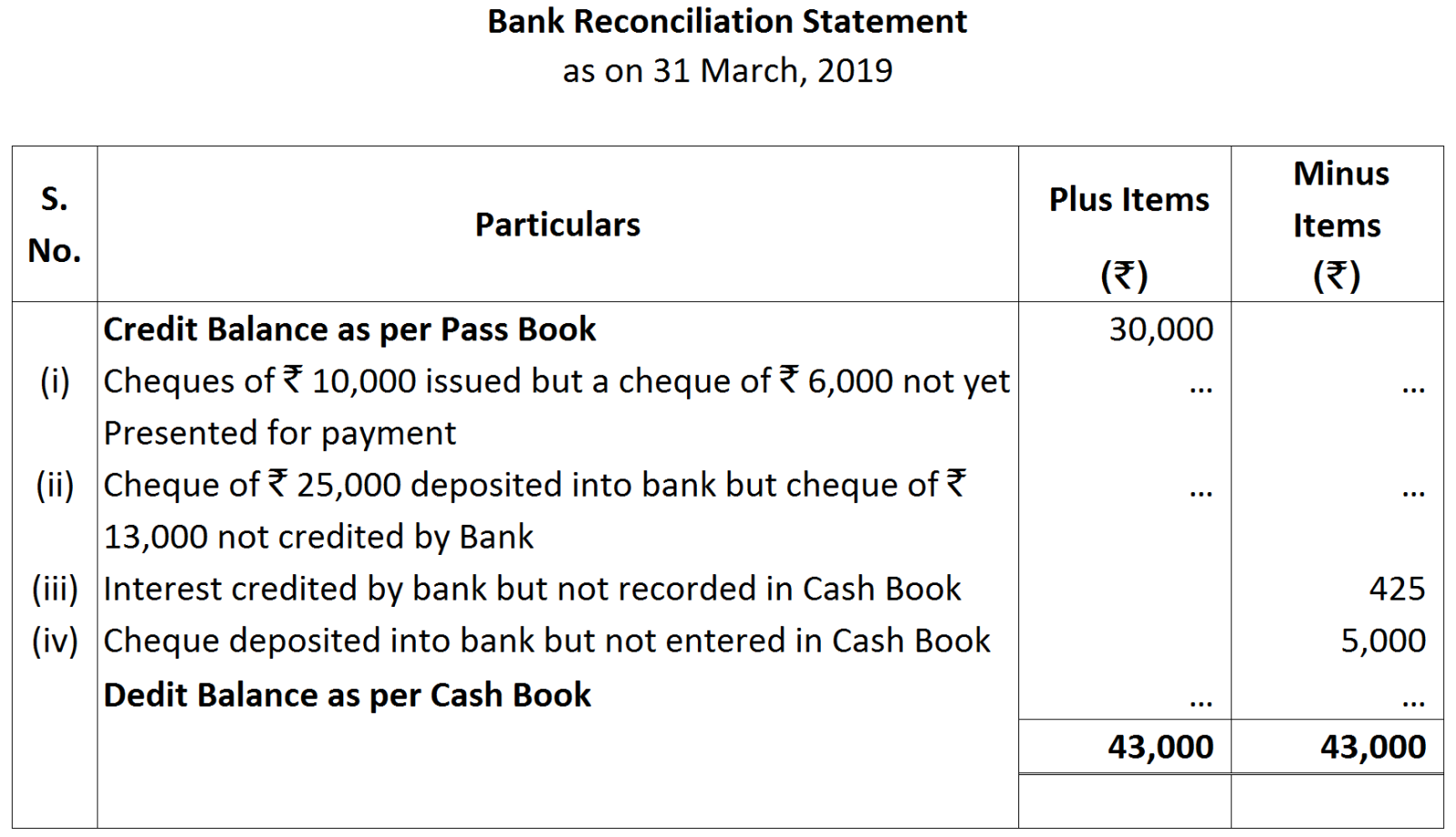
In the following Bank Reconciliation Statement. determine the missing amounts:
On 1st January, 2019, Ajay sold goods to Bhushan for ₹ 50,000. Ajay draws a bill of exchange for two months for the amount due which Bhushan accepts and returns it to Ajay. Bhushan met the bill on the due date. Pass Journal entries in the books of Ajay and Bhushan.
Rectify the following errors assuming that there is no Suspense Account:
  1. Salary of ₹ 5,000 paid to Rahul was not posted to Salaries Account.
  2. Sales to Amrish of ₹ 1,430 posted to his account as ₹ 1,340.
  3. Sales to Vijay of ₹ 2,470 posted to his account as ₹ 2,740.
  4. Purchases from Pal of ₹ 1,430 posted to his account as ₹ 1,340.
On 31st March, 2023, Bank Statement of Gopal shows credit balance of ₹ 33,570
whereas Cash Book showed debit balance of ₹ 53,000.
It was observed that the differences were because of the following:
i. Cheques and drafts sent to the bank but not collected and credited, amounted to ₹ 7,900 while cheque for ₹ 2,000 was received unpaid.
ii. Three cheques drawn for ₹ 3,000; ₹ 1,500 and ₹ 2,000 respectively were not presented for payment till 30th April, 2023.
iii. Bank has paid a cheque of ₹ 10,000 but it has not been entered in the Cash Book and a cheque of ₹ 5,000 which was discounted with the bank was dishonoured by the drawee on the due date.
iv. Bank has charged ₹ 130 as its commission for collecting outstation cheques and had credited an interest of ₹ 100 in the account.
v. A wrong debit of ₹ 5,000 was made by the bank, which was reversed on 4th April, 2023. Prepare Bank Reconciliation Statement as on 31st March, 2023.
From the following particulars prepare a bank reconciliation statement showing the balance as per cash book on December 31, 2016.
Two cheques of ₹ 2,000 and ₹ 5,000 were paid into bank in October, 2016 but were not credited by the bank in the month of December.
A cheque of ₹ 800 which was received from a customer was entered in the bank column of the cash book in December 2016 but was omitted to be banked in December, 2016.
Cheques for ₹ 10,000 were issued into bank in November 2016 but not credited by the bank on December 31, 2016.
Interest on investment ₹ 1,000 collected by bank appeared in the passbook.
Balance as per Passbook was ₹ 50,000
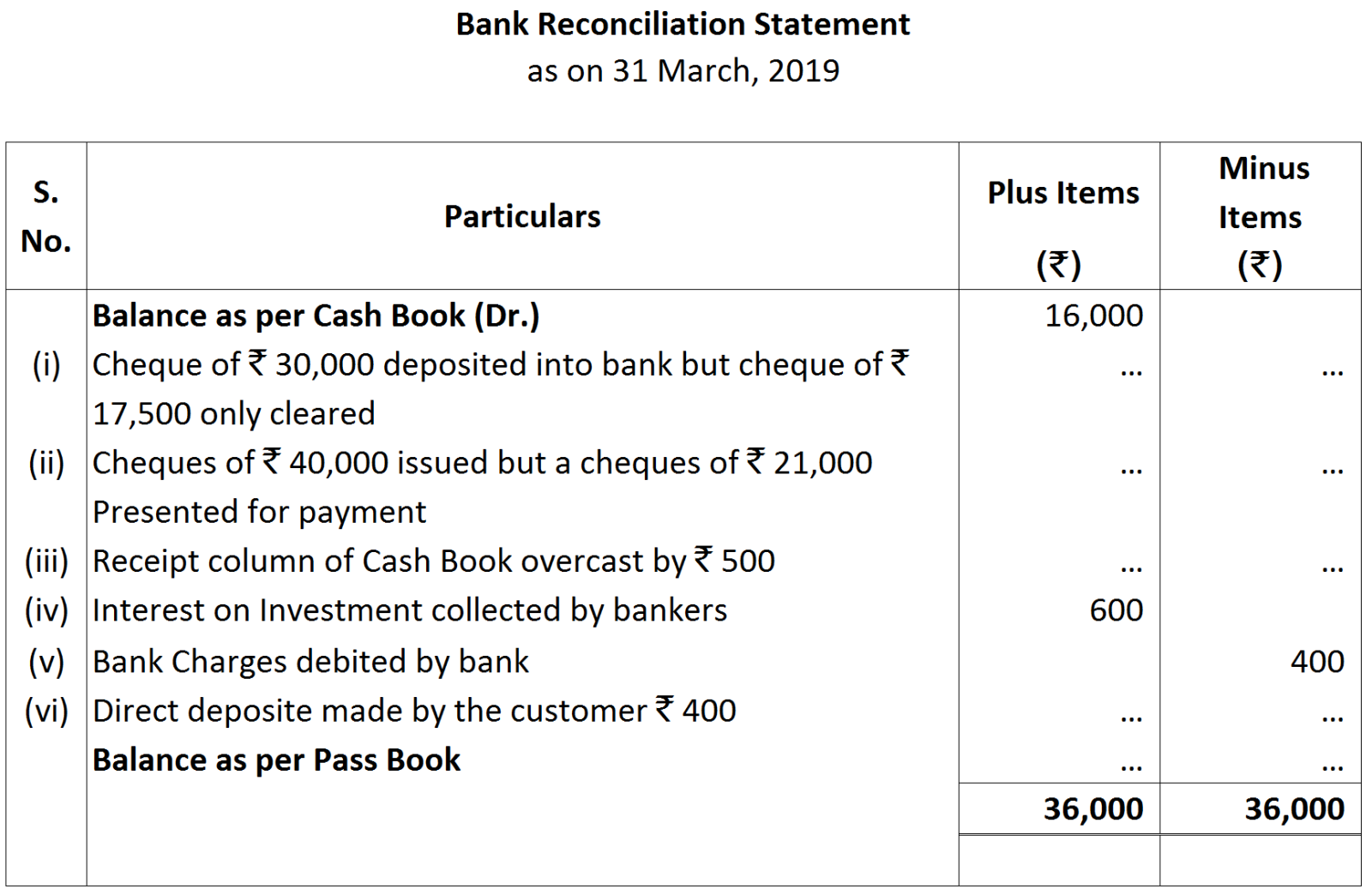
In the following Bank Reconciliation Statement. determine the missing amount:
On 1st January, 2019, A draws a bill on B for ₹ 1,000 payable after 3 months. Immediately after its acceptance, A sends the bill to his bank for collection. On the due date, the bill was dishonoured. Record the transactions in the Journals of A and B.
What is IGST? Give an example.