Question
  1. Define ‘activity’ of a radioactive material and write its S.I. unit.
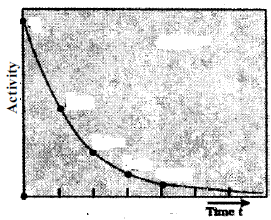
  2. Plot a graph showing variation of activity of a given radioactive sample with time.
  3. The sequence of stepwise decay of a radioactive nucleus is

If the atomic number and mass number of D2 are 71 and 176 respectively, what are their corresponding values for D?
Answer

  1. The total decay rate (of a sample)at the given instant, i.e., the number of radionuclides disintegrating per unit time is called the activity of that sample. The SI unit for activity is becquerel (Bq).
  2. Graph:

  1. 72 and 180.

Need a full question paper?

Generate a complete, print-ready paper with questions like this in minutes — across 16+ boards, with answer keys.

Start Generating Free

Similar questions

(a) Obtain the expression for the magnetic energy stored in a solenoid in terms of magnetic field $B$, area $A$ and length $l$ of the solenoid. (b) How does this magnetic energy compare with the electrostatic energy stored in a capacitor?
  1. Write the important properties of photons which are used to establish Einstein’s photoelectric equation.
  2. Use this equation to explain the concept of (i) threshold frequency and, (ii) Stopping potential.
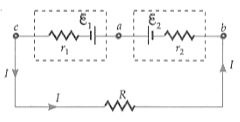
In Figure, $\varepsilon_1$ and $\varepsilon_2$ are respectively 2.0 V and 4.0 V and the resistances $r _1, r _2$ and R are respectively $1.0 \Omega$ $2.0 \Omega$ and $5.0 \Omega$. Calculate the current in the circuit. Also, calculate:
i. potential difference between the points b and a,
ii. potential difference between a and c.
Image
Identify the following electromagnetic radiations as per the wavelengths given below.
  1. 10-3nm
  2. 10-3m
  3. 1nm
Write one application of each.
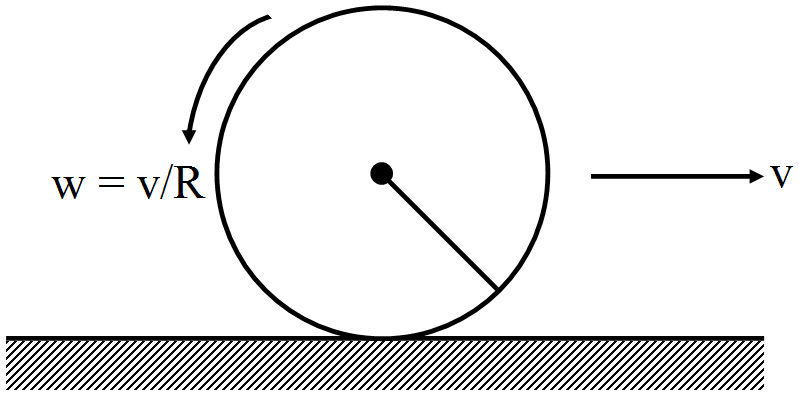
A solid sphere is set into motion on a rough horizontal surface with a linear speed v in the forward direction and an angular speed $\frac{\text{v}}{\text{R}}$ in the anticlockwise direction as shown in figure. Find the linear speed of the sphere:
  1. When it stops rotating.
  2. When slipping finally ceases and pure rolling starts.

A certain material has refractive indices 1.56, 1.60 and 1.68 for red, yellow and violet light respectively.
  1. Calculate the dispersive power.
  2. Find the angular dispersion produced by a thin prism of angle 6° made of this material.
Write and explain the super position principle (of waves).
What are the dimensions of:
  1. Volume of a cube of edge a.
  2. Volume of a sphere of radius a.
  3. The ratio of the volume of a cube of edge a to the volume of a sphere of radius a?
How is a galvanometer converted into a voltmeter and an ammeter? Draw the relevant diagrams and find the resistance of the arrangement in each case. Take resistance of galvanometer as G.
Light of wavelength 488 nm is produced by an argon laser which is used in the photoelectric effect. When light from this spectral line is incident on the emitter, the stopping (cut-off) potential of photoelectrons is 0.38 V. Find the work function of the material from which the emitter is made.