Question
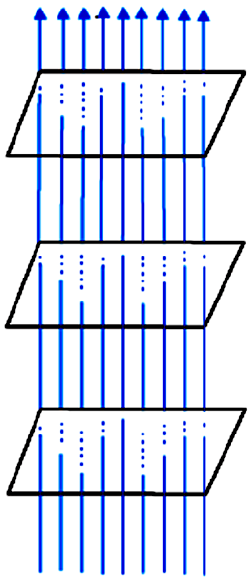
Define an equipotential surface. Draw equipotential surface:
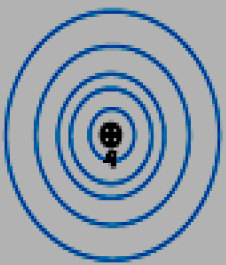
  1. In the case of a single point charge and,
  2. In a constant electric field in Z-direction.
Why the equipotential surfaces about a single charge are not equidistant?
  1. Can electric field exist tangential to an equipotential surface? Give reason.
Answer

Surface with a constant value of potential at all points on the surface.
  1.  

  1. $\text{V} \propto\frac{1}{\text{r}}/$
  1. No If the field lines are tangential, work will be done in moving a charge on the surface which goes against the definition of equipotential surface.

Need a full question paper?

Generate a complete, print-ready paper with questions like this in minutes — across 16+ boards, with answer keys.

Start Generating Free

Similar questions

A man is sitting on the shore of a river. He is in the line of a $1.0m$ long boat and is $5.5m$ away from the centre of the boat. He wishes to throw an apple into the boat. If he can throw the apple only with a speed of $10m/s,$ find the minimum and maximum angles of projection for successful shot. Assume that the point of projection and the edge of the boat are in the same horizontal level.
Calculate the change in internal energy of a gas kept in a rigid container when 100J of heat is supplied to it.
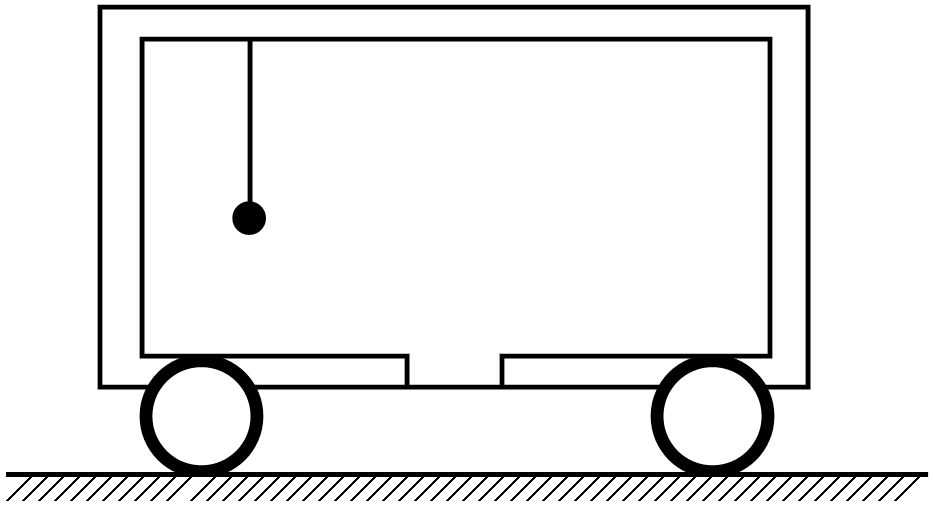
A cart of mass M is at rest on a frictionless horizontal surface and a pendulum bob of mass m hangs from the roof of the cart. The string breaks, the bob falls on the floor, makes several collisions on the floor and finally lands up in a small slot made in the floor. The horizontal distance between the string and the slot is L. Find the displacement of the cart during this process.
A magnifying glass is a converging lens placed close to the eye. A farsighted person uses spectacles having converging lenses. Compare the functions of a converging lens used as a magnifying glass and as spectacles.
Visible light has wavelengths in the range of 400nm to 780nm. Calculate the range of energy of the photons of visible light.
The current in a long solenoid of radius R and having n turns per unit length is given by $\text{i}=\text{i}_0\sin\omega\text{t}.$ A coil having N turns is wound around it near the centre. Find
  1. The induced emf in the coil.
  2. The mutual inductance between the solenoid and the coil.
Calculate the minimum and maximum wavelength of hydrogen spectrum emitted in the Balmer series. $(R_{H}=1.1\times10^{7}m^{-1})$
  1. Derive the expression for the capacitance of a parallel plate area $A$ and plate separation $d$.
  2. Two charged spherical conductors of radii $R_1$ and $R_2$​​​​​​​ when conducting wire acquire charges $q_1$​​​​​​​ and $q_2$​​​​​​​ respectively. surface charge densities in terms of their radii.
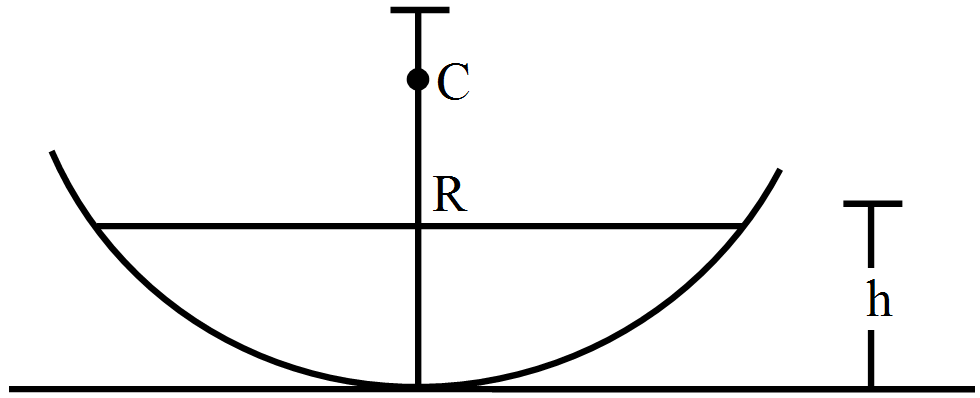
A concave mirror of radius R is kept on a horizontal. Water $\big($refractive index $=\mu\big)$ is poured into it upto a height h. Where should an object be placed so that its image is formed on itself?
The number of electrons in an insulator is of the same order as the number of electrons in a conductor. What is then the basic difference between a conductor and an insulator?