A functioning unit of genomic DNA containing a cluster of genes under the control of a single promoter is called an operon. An operon is generally transcribed into polycistronic mRNA. A single mRNA which codes for more than one protein is called polycistronic mRNA. An operon is made up of 3 basic DNA components:
i.
Promoter: A nucleotide sequence that enables a gene to be transcribed is called a promoter. It is recognized by RNA polymerase, which then initiates transcription.
ii.
Operator: A segment of DNA to which a repressor binds is called the operator.
iii.
Structural genes: The genes that are co-regulated by the operon are called structural genes.
Inducible Operon: When the operon is regulated by an inducer, it is called an inducible operon. An inducer can switch on or off the operon. Lac operon is an example of an inducible operon. Lactose is a substrate of enzyme beta-galactosidase and is the inducer of the lac operon.
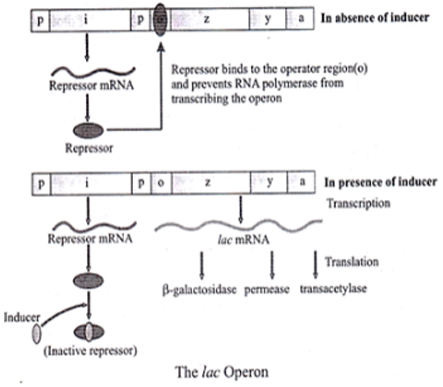
The given diagram shows the working of the lac operon. In the absence of an inducer, the repressor binds to the operator region and prevents transcription.
In the presence of an inducer, repressor becomes inactive. This allows transcription in the operator region which results in the release of mRNA. Subsequently, mRNA promotes translation and protein synthesis is accomplished