Question
Define an operon. giving an example, explain an Inducible operon.

Answer

A functioning unit of genomic DNA containing a cluster of genes under the control of a single promoter is called operon. An operon is generally transcribed into polycistronic mRNA. A single mRNA which codes for more than one protein is called polycistronic mRNA. An operon is made up of 3 basic DNA components:
  1. Promoter: A nucleotide sequence that enables a gene to be transcribed is called promoter. It is recognized by RNA polymerase, which then initiates transcription.
  2. Operator: A segment of DNA to which a repressor binds is called operator.
  3. Structural genes: The genes that are co-regulated by the operon are called structural genes.
Inducible Operon: When the operon is regulated by an inducer, it is called inducible operon. An inducer can switch on or off the operon. Lac operon is an example of inducible operon. Lactose is a substrate of enzyme beta-galactosidase and is the inducer of lac operon.
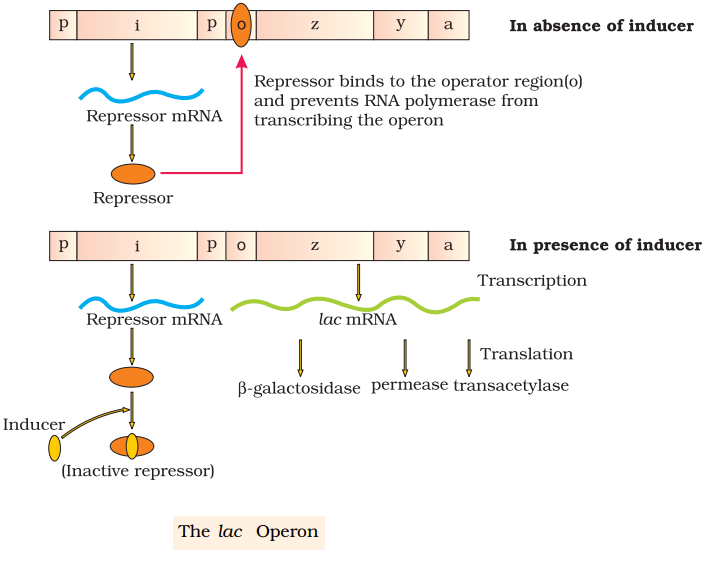
The given diagram shows the working of lac operon. In the absence of an inducer the repressor binds to the operator region and prevents transcription.
In the presence of an inducer, repressor becomes inactive. This allows transcription in the operator region which results in release of mRNA. Subsequently, mRNA promotes translation and protein synthesis is accomplished.
Need a full question paper?

Generate a complete, print-ready paper with questions like this in minutes — across 16+ boards, with answer keys.

Start Generating Free

Similar questions

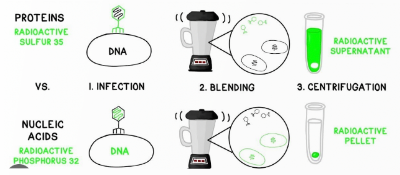
In 1952, Alfred Hershey and Martha Chase took an effort to find the genetic material in organisms. Their experiments led to an unequivocal proof to DNA as genetic material.
Image

Answer the following questions based on Hershey and Chases's experiments:
i. Name the kind of virus they worked with and why?
ii. Why did they use two types of culture media to grow viruses in? Explain.
iii. What was the need for using a blender and later a centrifuge during their experiments? OR
iv. State the conclusion drawn by them after the experiments.
Draw a labelled diagram of the L.S. of embryo of grasses. How does it differ from that of bean?
Explain the process of replication of a retrovirus after it gains entry into human body.
i. Describe the phenomenon of adaptive radiation as explained by Darwin.
ii. Is human evolution an example of adaptive radiation? Give reason in support of your answer.
Explain the Law of Dominance using a monohybrid cross.
A.
(i) Why is there a need to conserve biodiversity? (Any two reasons)
(ii) Name and explain any two causes that are responsible for the loss of biodiversity.
Draw a neat diagram of the female reproductive system and label the parts associated with the following (a) production of gamete, (b) site of fertilisation (c) site of implantation and, (d) birth canal.
What role does pituitary gonadotropins play during follicular and ovulatory phases of menstrual cycle and also explain the shift in steroidal secretions.
State the modifications of forelimb in animals as an example of homology.
  1. Differentiate between repetitive and satellite DNA.
  2. How can satellite DNA be isolated? Explain.
  3. List two forensic application of this technology.