Question
Define angular velocity. Show that the centripetal force on a particle undergoing uniform circular motion is $-m \omega^2 \vec{r}$.
Answer

Angular velocity of a particle is the rate of change of angular displacement.Expression for centripetal force on a particle undergoing uniform circular motion:
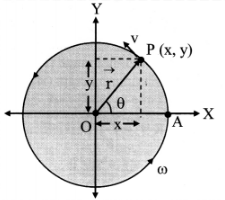
i) Suppose a particle is performing U.C.M in anticlockwise direction.
The co-ordinate axes are chosen as shown in the figure.
Let,
A = initial position of the particle which lies on positive X-axis
P = instantaneous position after time t
θ = angle made by radius vector
ω = constant angular speed
$\overrightarrow{ r }=$ instantaneous position vector at time $t$
ii) From the figure,
$\overrightarrow{ r }=\hat{ i } x +\hat{ j } y$
where, $\hat{ i }$ and $\hat{ j }$ are unit vectors along $X$-axis and $Y$-axis respectively.


Image
iii. Also, $x = r \cos \theta$ and $y = r \sin \theta$
$\therefore \quad \vec{r}=[r \hat{i} \cos \theta+r \hat{j} \sin \theta]$
But $\theta=\omega t$
$\therefore \quad \vec{r}=[r \hat{i} \cos \omega t+r \hat{j} \sin \omega t]$
iv. Velocity of the particle is given as rate of change of position vector.
$\therefore \quad \overrightarrow{ v }=\frac{\overrightarrow{d r}}{ dt }=\frac{ d }{ dt }[ r \hat{ i } \cos \omega t+r \hat{ j } \sin \omega t]$
$=r\left[\frac{d}{d t} \cos \omega t\right] \hat{i}+r\left[\frac{d}{d t} \sin \omega t\right] \hat{j}$
$\therefore \quad \vec{v}=-r \omega \hat{ i } \sin \omega t+r \omega \hat{j} \cos \omega t$
$\therefore \quad \vec{v}=r \omega(-\hat{i} \sin \omega t+\hat{j} \cos \omega t)$
v. Further, instantaneous linear acceleration of the particle at instant $t$ is given by,
$\overrightarrow{ a }=\frac{\overrightarrow{ dv }}{ dt }=\frac{ d }{ dt }[ r \omega(-\hat{ i } \sin \omega t+\hat{j} \cos \omega t)]$
$=r \omega\left[\frac{ d }{ dt }(-\hat{ i } \sin \omega t+\hat{ j } \cos \omega t)\right]$
$=r \omega\left[\frac{ d }{ dt }(-\sin \omega t ) \hat{ i }+\frac{ d }{ dt }(\cos \omega t ) \hat{ j }\right]$
$=r \omega(-\omega \hat{i} \cos \omega t-\omega \hat{j} \sin \omega t)$
$=-r \omega^2(\hat{ i } \cos \omega t +\hat{ j } \sin \omega t )$
$\therefore \quad \vec{a}=-\omega^2( r \hat{ i } \cos \omega t + r \hat{ j } \sin \omega t ) \ldots .(2)$
$\vec{a}=-\omega^2 \vec{r}$
Negative sign shows that direction of acceleration is opposite to the direction of position vector. Equation (3) is the centripetal acceleration.
vii) Magnitude of centripetal acceleration is given by $a = ω^2r$
viii) The force providing this acceleration should also be along the same direction, hence centripetal.
$\therefore \overrightarrow{ F }= m \overrightarrow{ a }=- m \omega^2 \overrightarrow{ r }$
This is the expression for the centripetal force on a particle undergoing uniform circular motion.
ix) Magnitude of $F=m \omega^2 r=\frac{m v^2}{r}=m \omega v$
[Note: The definition of angular velocity is not mentioned in this chapter but is in Ch.2
Mathematical Methods.]

Need a full question paper?

Generate a complete, print-ready paper with questions like this in minutes — across 16+ boards, with answer keys.

Start Generating Free

Similar questions

If $n$ identical cells, each of emf $E$ and internal resistance $r,$ are connected in series, write an expression for the terminal $p.d$. of the combination and hence show that this is nearly $n$ times that of a single cell.
State and prove parallelogram law of vector addition and determine magnitude and direction of resultant vector.
A person uses spectacles of ‘number’ 2.00 for reading. Determine the range of magnifying power (angular magnification) possible. It is a concave convex lens (n = 1.5) having curvature of one of its surfaces to be 10 cm. Estimate that of the other.
Explain why the Earth doesn't appear to move even though the object of mass $m \  \ ( m << M )$ kept on the Earth exerts equal and opposite gravitational force on it.
Distinguish between p-type and n-type semiconductor.
If the measured values of two quantities are $A \pm \Delta A$ and $B \pm \Delta B, \triangle A$ and $\Delta B$ being the mean absolute errors. What is the maximum possible error in $A \pm B$ ? Show that if $Z=\frac{A}{B}$ $\frac{\Delta Z}{Z}=\frac{\Delta A}{A}+\frac{\Delta B}{B}$
Describe construction and working of an optical fibre. What are the advantages of optical fibre communication over electronic communication?
Explain the velocity$-$tune graphs of an object:
$i)$ Moving with zero acceleration.
$ii)$ Moving with constant positive acceleration.
$iii)$ Moving with constant negative acceleration.
$iv)$ Moving with non-uniform acceleration.
A simplified model of hydrogen atom consists of an electron revolving about a proton at a distance of $5.3 \times 10^{-11} m.$ The charge on a proton is $+1.6 \times 10^{-19} C.$ Calculate the intensity of the electric field due to proton at this distance. Also find the force between electron and proton.
If the Earth were a perfect sphere of radius $6.4 \times 10^6 m$ rotating about its axis with the period of one day $(8.64 \times 10^4 s),$ what is the difference in acceleration due to gravity from poles to equator?