Question
Define capacitance of a capacitor and its SI unit.

Answer

Capacitance
Image
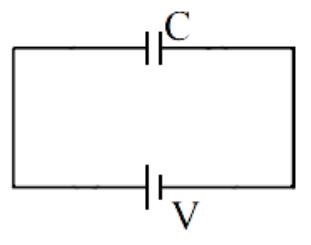
Capacitor is a device which is used to store charge. The capacity of a capacitor to store charge is called capacitance.
\(C=\frac{ Q }{ V }\)
SI unit of capacitor is farad.
 

Need a full question paper?

Generate a complete, print-ready paper with questions like this in minutes — across 16+ boards, with answer keys.
Start Generating Free

Similar questions

A coil of 100 turns, each of area \(0.02 m ^2\) is kept in a uniform field of induction \(3.5 \times 10^{-5} T\). If the coil rotates with a speed of 6000 r.p.m. about an axis in the plane of the coil and perpendicular to the magnetic induction, calculate peak value of e.m.f. induced in the coil.
Two slits in Young's experiment have widths in the ratio $2: 3$. What is the ratio of the intensities of light waves coming from them?
Define angle of contact.
A simple harmonic progressive of frequency $100 Hz$ and wavelength $0.5 m$ travels through a medium. If the path difference between two points in the path of the wave is $0.1 m$, what is the corresponding phase difference?
What do you mean by viscous drag?
Compare the rate of radiation of metal bodies at $727 ^{\circ} C$ and $227 ^{\circ} C.$
A Plane Wavefront of light of wavelength 5500 A.U. is incident on two slits in a screen perpendicular to the direction of light rays. If the total separation of 10 bright fringes on a screen 2 m away is 2 cm. Find the distance between the slits.
The difference between two molar specific heats of a gas is \(6000 J / kg\). K. If the ratio of specific heats is 1.4 calculate the molar specific heat at constant volume.
A lawn roller of mass $80 \mathrm{~kg}$, radius $0.3 \mathrm{~m}$ and moment of inertia $3.6 \mathrm{~kg} \cdot \mathrm{m}^2$, is drawn along a level surface at a constant speed of $1.8 \mathrm{~m} / \mathrm{s}$. Find
(i) the translational kinetic energy
(ii) the rotational kinetic energy
(iii) the total kinetic energy of the roller.
A torque of magnitude $400 \mathrm{~N}-\mathrm{m}$, acting on a body of mass $40 \mathrm{~kg}$, produces an angular acceleration of $20 \mathrm{rad} / \mathrm{s}^2$. Calculate the moment of inertia and radius of gyration of the body.