Question
Define centripetal force. A cyclist speeding at 18km/ hr on a level road takes a sharp circular turn of radius 3m without reducing the speed. The coefficient of static friction is 0.1. Will the cyclist slip while taking the turn?

Answer

The force on the body towards the centre while it is moving is a circular path. The condition for the cyclist not to slip is $\text{V}^2\leq\mu_\text{s}\times\text{R}\times\text{g}$ $\text{V}^2\leq0.1\times3\times9.8$ $\text{V}^2=2.94\text{m}^2/\text{s}^2$ But the speed of the cyclist is $18\text{km}/\text{hr}=5\text{m}/\text{s}$ $\therefore\text{V}^2=25\text{m}^2/\text{s}^2$ $\therefore$ The condition is not obeyed $\therefore$ The cyclist will slip.

Need a full question paper?

Generate a complete, print-ready paper with questions like this in minutes — across 16+ boards, with answer keys.
Start Generating Free

Similar questions

The time of oscillation (t) of a small drop of liquid under surface tension depends upon the density $\rho,$ radius r and surface tension $\sigma.$ Prove dimensionally that to: $\text{t}\propto\sqrt{\frac{\rho\text{r}^3}{\sigma}}.$
A railroad car of mass M is at rest on frictionless rails when a man of mass m starts moving on the car towards the engine. If the car recoils with a speed v backward on the rails, with what velocity is the man approaching the engine?
Why are the wings of an aeroplane rounded outwards while flattened inwards?
The transverse displacement of a string (clamped at its both ends) is given by
$\text{y}(\text{x, t})=0.06\sin\Big(\frac{2\pi}{3}\text{x}\Big)\cos(120\pi\text{ t})$
where x and y are in m and t in s. The length of the string is 1.5m and its mass is $3.0 \times 10^{–2}kg$.
Answer the following:
Does the function represent a travelling wave or a stationary wave?
A simple microscope using a single lens often shows coloured image of a white source. Why?
State the rules for finding the number of significant figures in a measurement.
Explain why The blood pressure in humans is greater at the feet than at the brain.
A copper wire of diameter 1.6 mm carries 20A. Find the maximum magnitude of the magnetic field $\overrightarrow{\text{B}}$ due to this current.
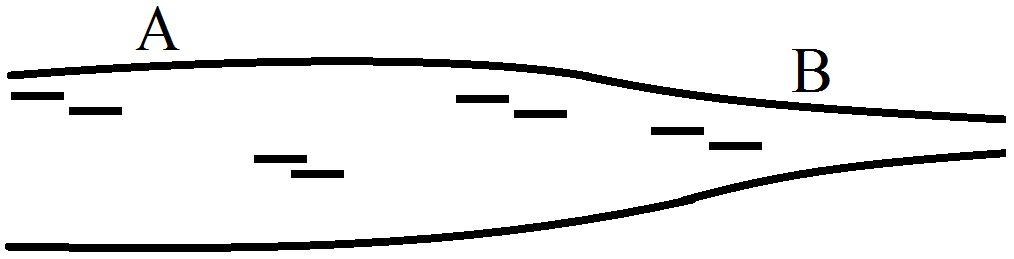
Water flows through a horizontal tube of variable cross$-$section. The area of cross$-$section at $A$ and $B$ are $4mm^2$ and $2mm^2$ respectively. If $1cc$ of water enters per second through $A$, find,
  1. The speed ofwater at $A$.
  2. The speed of water at $B.$
  3. Thepressure difference $P_A- P_B$.
Two particles A and B are moving along the same straight line. B is ahead of A. Velocities remaining unchanged, what would be the effect on the magnitude of relative velocity if A is ahead of B?