Question
Define conservative and non-conservative forces and also describe their examples.

Answer

self

Need a full question paper?

Generate a complete, print-ready paper with questions like this in minutes — across 16+ boards, with answer keys.
Start Generating Free

Similar questions

Consider that an ideal gas (n moles) is expanding in a process given by P = f( V ), which passes through a point (V0, P0 ). Show that the gas is absorbing heat at (P0, V0 ) if the slope of the curve P = f(V ) is larger than the slope of the adiabat passing through (P0, V0 ).
The edge of an aluminium cube is 10cm long. One face of the cube is firmly fixed to a vertical wall. A mass of 100kg is then attached to the opposite face of the cube. The shear modulus of aluminium is 25G Pa. What is the vertical deflection of this face?
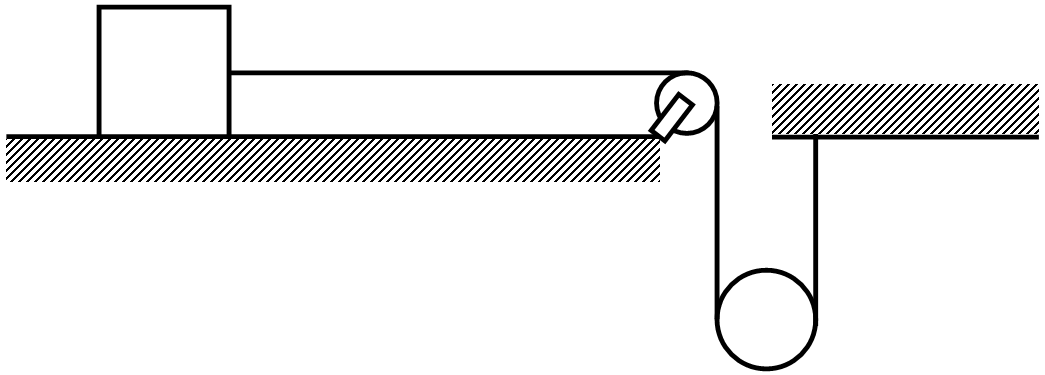
The descending pulley shown in figure has a radius 20cm and moment of inertia 0.20kg-m2. The fixed pulley is light and the horizontal plane frictionless. Find the acceleration of the block if its mass is 1.0kg.

Toricelli’s barometer used mercury. Pascal duplicated it using French wine of density 984kg m–3. Determine the height of the wine column for normal atmospheric pressure.
Show that if n equal rain droplets falling through air with equal steady velocity of 10cm s-1 coalesce, the resultant drop attains a new terminal velocity of 10n2/3cm s-1.
Suppose the friction coefficient between the ground and the ladder of the previous problem is 0.540. Find the maximum weight of a mechanic who could go up and do the work from the same position of the ladder.
Two masses 8kg and 12kg are connected at the two ends of a light inextensible string that goes over a frictionless pulley. Find the acceleration of the masses and the tension in the string when the masses are released.
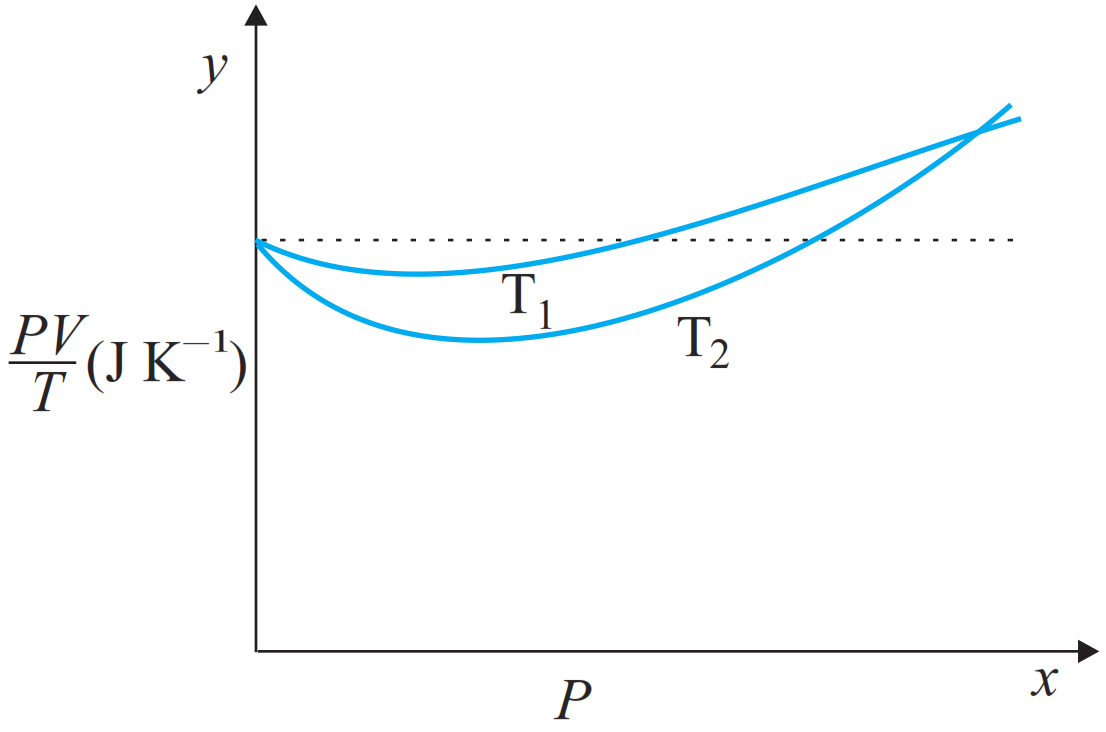
Shows plot of $\frac{\text{PV}}{\text{T}}$ versus P for 1.00 × 10⁻³kg of oxygen gas at two different temperatures:

What is the value of $\frac{\text{PV}}{\text{T}}$ where the curves meet on the y-axis?

A gas mixture consists of 2.0 moles of oxygen and 4.0 moles of neon at temperature T. Neglecting all vibrational modes, calculate the total internal energy of the system. (Oxygen has two rotational modes.)
Two vector forces 5 N and 3 N are acting on a particle. Find the magnitude and direction of resultant force.(a) When both the forces are in same direction.(b) When both the forces are at right angles.(c) When both the forces are inclined at angle $60^{\circ}$.