Question
Define conservative and non-conservative forces. Give example and properties of conservative forces.
A 5kg rifle fires a 58 bullet with a speed of 500ms-1. What kinetic energy is acquired.
  1. By the bullet and.
  2. By the rifle?
  3. Find the the ratio of the distance which the rifle moves backward while the bullet is in the barrel to the distance the bullet moves forward.

Answer

Conservative force: A force is said to be conservative if work done by or against the force in moving a body depends only on the initial and final positions of the body and not on the nature of path followed between the initial and final positions.

Non-conservative forces: A force is said to be non-conservative if work done by or against the force in moving a body depends upon the path between the initial and final positions.

Examples of Conservative Forces:

  1. Gravitational force, not only due to the Earth but in its general form as given by the universal law of gravitation, is a conservative force.
  2. Elastic force in a stretched or compressed spring is a conservative force.
  3. Electrostatic force between two stationary electric charges is a conservative force.
  4. Magnetic force between two magnetic poles is a conservative force.
Properties of Conservative Forces:

  1. Work done by or against a conservative force depends only on the initial and final positions of the body.
  2. Work done by or against a conservative force does not depend upon the nature of the path between initial and final positions of the body.
  3. Work done by or against a conservative force in a round trip is zero.
  4. The work done by a conservative force is completely recoverable.
Numerical:

Mass of rifle, M = 5 kg;

Mass of bullet, m = 5g = 5 × 10-3 kg

Speed of bullet, v = 500 ms-1

  1. Kinetic energy acquired by bullet,

$\text{K}_1=\frac{1}{2}\text{m}\upsilon^2=\frac{1}{2}\times5\times10^{-3}\times(500)^2=625\text{ J}$

  1. According to the law of conservation of momentaum (As no external force acts on the bullet or rifle)

$0=\text{MV}+\text{m}\upsilon$

$\therefore$ V (speed of rifle) $=\frac{\text{m}\upsilon}{\text{M}}=-\frac{5\times10^{-3}\times500}{5}$

⇒ V = -0.5 ms-1

$-\upsilon\text{e}$ sign shows that rifle recoils back.

$\therefore$ Kinetic energy of rifle $\frac{1}{2}\text{M}\text{V}^2$

$\frac{1}{2}\times5\times(-0.5)^2=0.625\text{ J}$

  1. Since $\text{m}\upsilon+\text{MV}= 0$

or $\text{m}\frac{\text{dx}_1}{\text{dt}}+\text{M}\frac{\text{dx}_2}{\text{dt}}=0$

$ \begin{bmatrix}\text{Q}\text{V}=\frac{\text{dx}_1}{\text{dt}}=\frac{\text{Distance moved by bullet}}{\text{times}}\\\text{V}=\frac{\text{dx}_2}{\text{dt}}=\frac{\text{Distance moved by rifle}}{\text{time}}\end{bmatrix}$

$\therefore$ mdx1 + Mdx2 = 0

$\Big|\frac{\text{dx}_2}{\text{dx}_1}\Big|=\frac{\text{m}}{\text{M}}=\frac{5\times10^{-3}}{5}=\frac{1}{1000}$.
Need a full question paper?

Generate a complete, print-ready paper with questions like this in minutes — across 16+ boards, with answer keys.

Start Generating Free

Similar questions

State the assumptions of the kinetic theory of gases. The density of carbon dioxide gas at 0°C and at a pressure of 1.0 × 10⁵ newton/ metre2 is 1.98 kg/ m3. Find the root mean square velocity of its molecules at 0°C and 30°C. Pressure is constant.
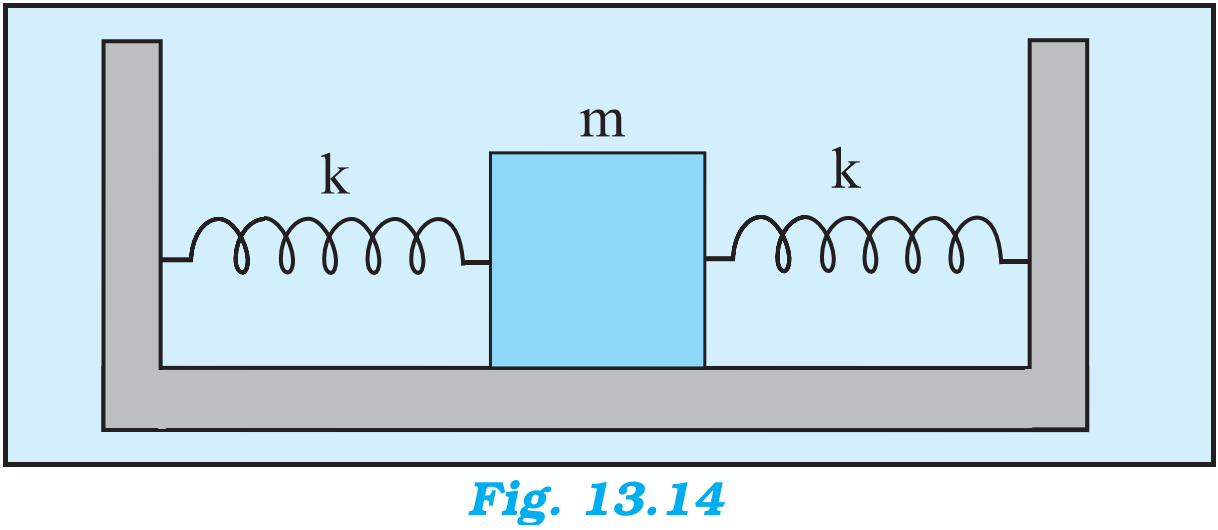
Two identical springs of spring constant k are attached to a block of mass m and to fixed supports as shown in Fig. 13.14. Show that when the mass is displaced from its equilibrium position on either side, it executes a simple harmonic motion. Find the period of oscillations.
Image
A fighter plane is flying horizontally at an altitude of 1.5 km with a speed of $720 km / h$. At what angle of sight (w.r.t horizontal) when the target is seen, should the pilot drop the bomb in order to attack the target?
Main concept used: $u =720 km / h =720 \times \frac{5}{18} m / s =200 m / s$
If the earth were a homogeneous sphere and a straight hole bored in it through its centre, show that if a body were dropped into the hole it would execute a simple harmonic motion. Also find its time period.
A ball of mass 100g is projected vertically upwards from the ground with a velocity of 49m/s. At the same time another identical ball is dropped from a height of 98m to fall freely along the same path as followed by the first ball. After sometime, the two balls collide and stick together and finally fall together. Find the time of flight of the masses.
A car of mass 1000kg accelerstes uniformly from rest to I veloclty of 54km/ h in 5 seconds.
Calculate:
  1. Its acceleration.
  2. Its gain in K.E.
  3. Average power of the engine during this period Neglect friction.
A person travels by a car at a speed of 180km/h. It takes exactly 10 hours by his wristwatch to go from the station A to the station B:
  1. What is the rest distance between the two stations?
  2. How much time is taken in the road frame by the car to go from the station A to the station B?
For the wave on a string described in Exercise 15.11, do all the points on the string oscillate with the same,
  1. Frequency,
  2. Phase,
  3. Amplitude?
A woman starts from her home at 9.00 am, walks with a speed of 5km h–1 on a straight road up to her office 2.5km away, stays at the office up to 5.00 pm, and returns home by an auto with a speed of 25km h–1. Choose suitable scales and plot the x-t graph of her motion.
A block of mass 2.0kg kept at rest on an inclined plane of inclination 37° is pulled up the plane by applying a constant force of 20N parallel to the incline. The force acts for one second.
  1. Show that the work done by the applied force does not exceed 40J.
  2. Find the work done by the force of gravity in that one second if the work done by the applied force is 40J.
  3. Find the kinetic energy of the block at the instant the force ceases to act. Take g = 10m/s2.