Question
Define current density. State its unit.

Answer

Magnitude of current flowing in the perpendicular direction of unit area of cross-section is known as current density J.
Current density $J =\frac{ i }{\Delta S }$, where, $\Delta S$ is area of cross-section.
If the direction of flow of charge is inclined at an angle with the perpendicular, then
current density, $J=\frac{i}{\Delta S \cos\theta}$ or $I=\vec{J} \cdot \overrightarrow{\Delta S}$

Need a full question paper?

Generate a complete, print-ready paper with questions like this in minutes — across 16+ boards, with answer keys.

Start Generating Free

Similar questions

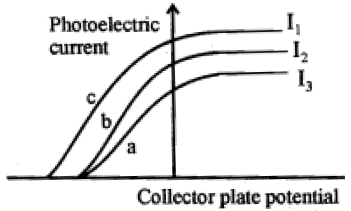
The figure shows a plot of three curves a, b, c showing the variation of photocurrent vs collector plate potential for three different intensities I1, I2 and I3 having frequencies $\sqrt{1} ,\sqrt{2}$ and $\sqrt{3}$, respectively incident on a photosensitive surface.

Point out the two curves for which the incident radiations have same frequency but different intensities.
 

Write the law of reflection.
Mark the correct options.
  1. The luminous efficiency of a monochromatic source is always greater than that of a white light source of same power.
  2. The luminous efficiency of a monochromatic source of wavelength 555nm is always greater than that of a white light source of same power.
  3. The illuminating power of a monochromatic source of wavelength 555nm is always greater than that of a white light source of same power.
  4. The illuminating power of a monochromatic source is always greater than that of a white light source of same power.
Write the formula to determine the value of electric field intensity due to a uniformly charged thin spherical shell.
Show variation of resistivity of Si with temperature in a graph.
What will be the relationship between the mass loss $\Delta M$ of a nucleus and its binding energy ( E )?
Does the value of electric flux depend on the shape of the Gaussian surface?
Give two factors by which the voltage sensitivity of a moving coil galvanometer can be increased.
A photosensitive surface emits photoelectrons when red light falls on it. Will the surface emit photoelectrons when blue light is incident on it? Give reason.
An experimenter measures the length of a rod. In the cases listed, all motions are with respect to the lab and parallel to the length of the rod. In which of the cases the measured length will be minimum?
  1. The rod and the experimenter move with the same speed v in the same direction.
  2. The rod and the experimenter move with the same speed v in opposite directions.
  3. The rod moves at speed v but the experimenter stays at rest.
  4. The rod stays at rest but the experimenter moves with the speed v.