Question
Define elastic and inelastic collisions. Write their basic characteristics. A bullet is fired into a block of wood. If it gets totally embedded in it and the system moves together as one entity, then state what happens to the initial kinetic energy and linear momentum of the bullet?
Answer

Elastic collision: A collision in which there is absolutely no loss of kinetic energy is called elastic collision.

Characteristics :

  1. The linear momentum is conserved.
  2. Total energy of system is conserved.
  3. Kinetic energy is conserved.
  4. Forces involved during elastic collisions must be conservative forces.
Inelastic collision: A collision in which there occurs some loss of kinetic energy is called inelastic collision.

Characteristics :

  1. Linear momentum is conserved.
  2. Total energy is conserved.
  3. K.E. is not conserved.
  4. Some or all forces involved may be non-conservative.
Consider two particles A and B of masses m1 and m2 moving with initial velocities u1 and u2 along x-axis. They collide and move as one entity. Let V be the common velocity when they move as single mass.

m1 = Mass of bullet

u1 = Initial velocity of bullet

m2 = Mass of wood.

u2 = Initial velocity of wood = 0

According to conservation of momentum.

mu1 + m2 u2 = ( m1 + m2 )V

u2 = 0 

$\text{V}=\frac{\text{m}_1\text{u}_2}{\text{m}_1+\text{m}_2}\cdots{\text{i}}$

Initial K.E, $\text{k}_\text{i}\frac{1}{2}\text{m}_1\text{u}_1^2$

Final K.E., $\text{k}_\text{f}=\frac{1}{2}(\text{m}_1+\text{m}_2)\text{V}^2$

$\frac{\text{K}_\text{f}}{\text{K}_\text{i}}=\frac{\frac{1}{2}(\text{m}_1+\text{m}_2)\text{V}^2}{\frac{1}{2}\text{m}_1\text{u}_1^2}$

$=\Big(\frac{\text{m}_1+\text{m}_2}{\text{m}_1}\Big)\frac{\text{V}^2}{\text{u}_1^2}\ \cdots\text{(ii)}$

From (i) and (ii)

$\frac{\text{K}_\text{f}}{\text{K}_\text{i}}=\Big(\frac{\text{m}_1\text{m}_2}{\text{m}_1}\Big)\Big(\frac{\text{m}_1}{\text{m}_1+\text{m}_2}\Big)^2$

$=\frac{\text{m}_1}{\text{m}_1+\text{m}_2}$

When, $\text{K}_\text{f}<\text{K}_\text{i}$ there is loss in K.E.

Need a full question paper?

Generate a complete, print-ready paper with questions like this in minutes — across 16+ boards, with answer keys.

Start Generating Free

Similar questions

A gun is mounted on a railroad car. The mass of the car, the gun, the shells and the operator is 50m where m is the mass of one shell. If the velocity of the shell with respect to the gun (in its state before firing) is 200m/s, what is the recoil speed of the car after the second shot? Neglect friction.
Briefly describe the Cavendish torsion balance. How is it used to measure G?
A ball is dropped from a height of 90 m on a floor. At each collision with the floor the ball loses one tenth of its speed. Plot the speed-time graph of its motion between t = 0 to 12 s.
Two identical steel cubes (masses 50g, side 1cm) collide head-on face to face with a speed of 10cm/ s each. Find the maximum compression of each. Young’s modulus for steel = Y = 2 × 10¹¹ N/ m2.
Assume that a tunnel is dug across the earth (radius = R) passing through its centre. Find the time a particle takes to cover the length of the tunnel if,
  1. It is projected into the tunnel with a speed of $\sqrt{\text{gR}}.$
  2. It is released from a height R above the tunnel.
  3. It is thrown vertically upward along the length of tunnel with a speed of $\sqrt{\text{gR}}.$
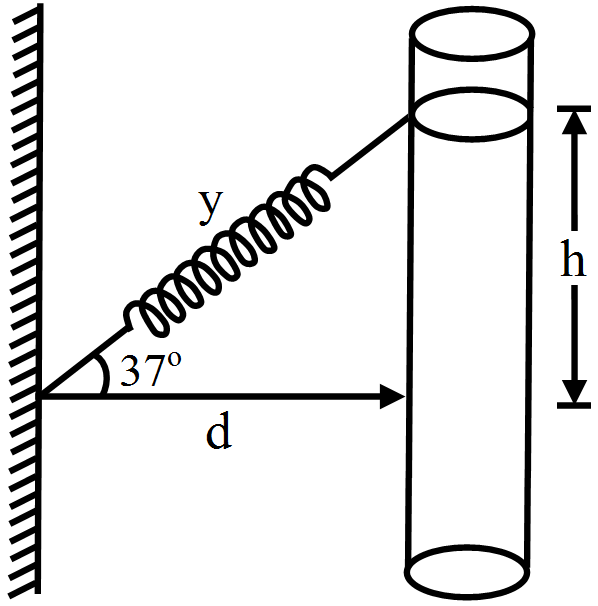
One end of a light spring of natural length d and spring constant k is fixed on a rigid wall and other end is fixed in a smooth ring of mass m as shown in figure. Initially, the spring is stretched such that it makes an angle of 37° with the horizontal.

Now, the ring is stretched from rest, find the speed of the ring when it will become horizontal, assume that ring slides on the vertical wall without friction.

A copper wire having resistance 0.01 ohm in each metre is used to wind a 400-turn solenoid of radius 1.0cm and length 20cm. Find the emf of a battery which when connected the solenoid will eauee a magnetic field of 1.0 × 10⁻²T near the centre of the solenoid.
In nature, the failure of structural members usually result from large torque because of twisting or bending rather than due to tensile or compressive strains. This process of structural breakdown is called buckling and in cases of tall cylindrical structures like trees, the torque is caused by its own weight bending the structure. Thus the vertical through the centre of gravity does not fall within the base. The elastic torque caused because of this bending about the central axis of the tree is given by $\frac{\text{Y}\pi\text{r}^4}{4\text{R}}.$ Y is the Young’s modulus, r is the radius of the trunk and R is the radius of curvature of the bent surface along the height of the tree containing the centre of gravity (the neutral surface). Estimate the critical height of a tree for a given radius of the trunk.
Write the statement of Bernoulli's principle and prove it. Write its limitation of Bernoulli's principle.
Can the work by kinetic friction on an object be positive? Zero?