Question
Define electric field intensity and equipotential surface in current carrying conductor.

Answer

Electric Field Intensity : In a current carrying conductor the ratio of potential difference applied across the ends of the conductor and the length of the conductor is equal to the electric field intensity at any point in the conductor. i.e.
$ E = V/l $
where $ V = $ potential difference and $ l = $ length.
Equipotential Surface : In a currnet carrying conductor electric currnet flows from the end of higher potential towards the end of lower potential. Hence electric potential decreases with increase the distance from the end of higher potential toward the end of lower potential but the electric potential at all points lying on any cross-section of the conductor is the same. Hence any cross-section of the conductor is equipotential surface.

Need a full question paper?

Generate a complete, print-ready paper with questions like this in minutes — across 16+ boards, with answer keys.
Start Generating Free

Similar questions

Derive/obtain the equation of current in case of AC voltage applied to a resistor and also draw the graph showing the phase difference between voltage and current.
When are two objects just resolved? Explain. How can the resolving power of a compound microscope be increased? Use relevant formula to support your answer.
  1. State the condition under which a large magnification can be achieved in an astronomical telescope.
  2. Give two reasons to explain why a reflecting telescope is preferred over a refracting telescope.
Draw the field lines of Simple electric charge distribution.
A load of 10kg is suspended by a metal wire 3m long and having a cross-sectional area 4mm2. Find.
  1. The stress.
  2. The strain and.
  3. The elongation. Young's modulus of the metal is 2.0 × 10N11N/ m2.
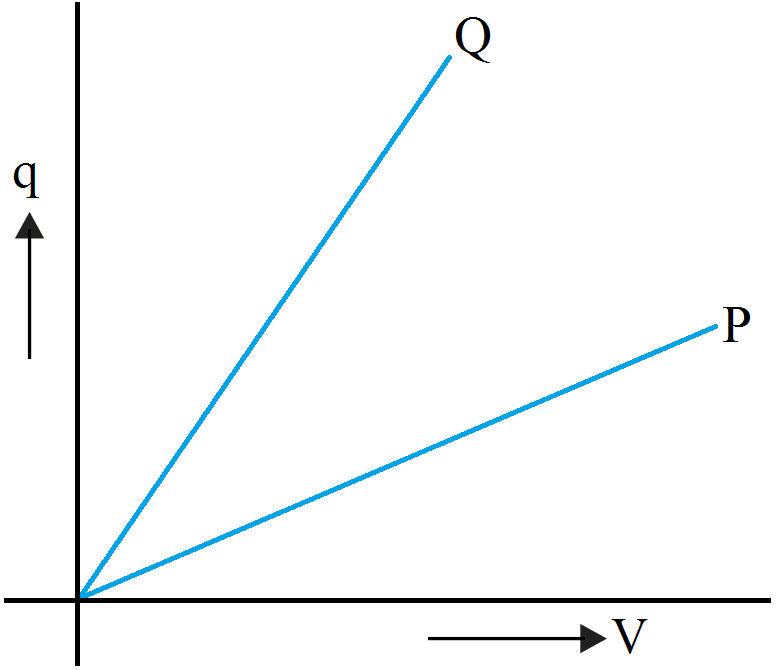
The given graph shows the variation of charge q versus potential difference V for two capacitors C1 and C2. The two capacitors have same plate separation but the plate area of C2 is double than that of C1. Which of the two graphs P and Q correspond to capacitors C1 and C2 and why?

Two identical phase connected waves, each of intensity $I _0$, are producing interference patterns. Write the value of the resultant intensity at the places of (i) constructive interference, (ii) destructive interference
White light is used in a Young's double slit experiment. Find the minimum order of the violet fringe $(\lambda=400\text{nm}),$ which overlaps with a red fringe $(\lambda=700\text{nm}).$
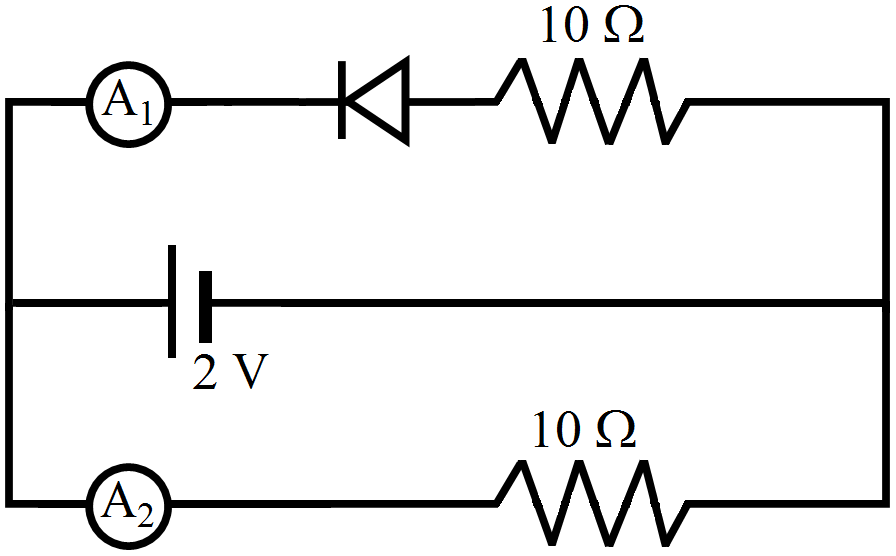
What are the readings of the ammeters A1 and A2 shown in figure. Neglect the resistance of the meters.

A charged 30μF capacitor is connected to a 27mH inductor. What is the angular frequency of free oscillations of the circuit?