Question
Define electric field strength. Is it a vector or a scalar quantity?

Answer

The electric field strength at a point in an electric field is defined as the electrostatic force acting on a unit positive charge when placed at that point and its direction is along the direction of electrostatic force.
Electric field strength is a vector quantity.

Need a full question paper?

Generate a complete, print-ready paper with questions like this in minutes — across 16+ boards, with answer keys.
Start Generating Free

Similar questions

A ball is projected from a point on the floor with a speed of 15m/s at an angle of 60° with the horizontal. Will it hit a vertical wall 5m away from the point of projection and perpendicular to the plane of projection without hitting the floor? Will the answer differ if the wall is 22m away?
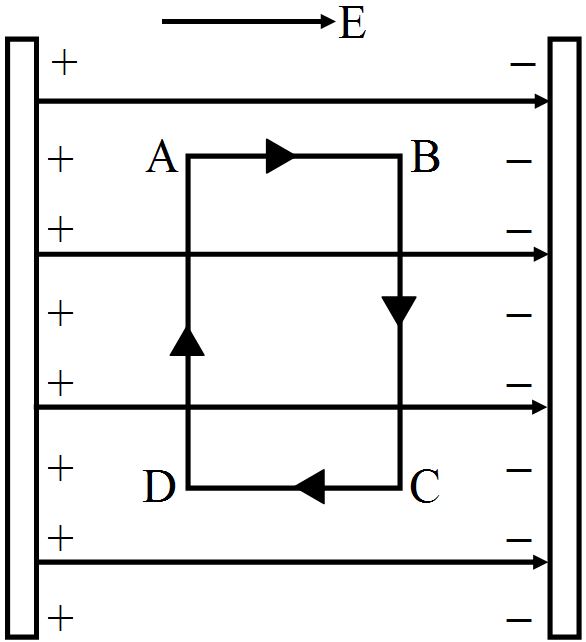
A uniform electric field exists between two charged plates as shown in the fig. What should be the work done in moving a charge q along the closed rectangular path ABCDA?

On changing a current carrying coil of N turns and R radius into a straight wire, how many times the magnetic field at distance R will be than at the magnitude at the center of the coil?
A semicircular wire of radius 5.0cm carries a current of 5.0A. A magnetic field B of magnitude 0.50T exists along the perpendicular to the plane of the wire. Find the magnitude of the magnetic force acting on the wire.
Explain the particle nature of light.
###
Explain the characteristics of photon.
Explain hard ferromagnetic and soft ferromagnetic materials.
A body is weighed by a spring balance to be 1.000kg at the north pole. How much will it weigh at the equator? Account for the earth's rotation only.
A parallel plate capacitor made of circular plates each of radius R = 6.0 cm has a capacitance C = 100 pF. The capacitor is connected to a 230 V ac supply with a (angular) frequency of 300 rad s-1.
  1. What is the rms value of the conduction current?
  2. Is the conduction current equal to the displacement current?
  3. Determine the amplitude of B at a point 3.0 cm from the axis between the plates.
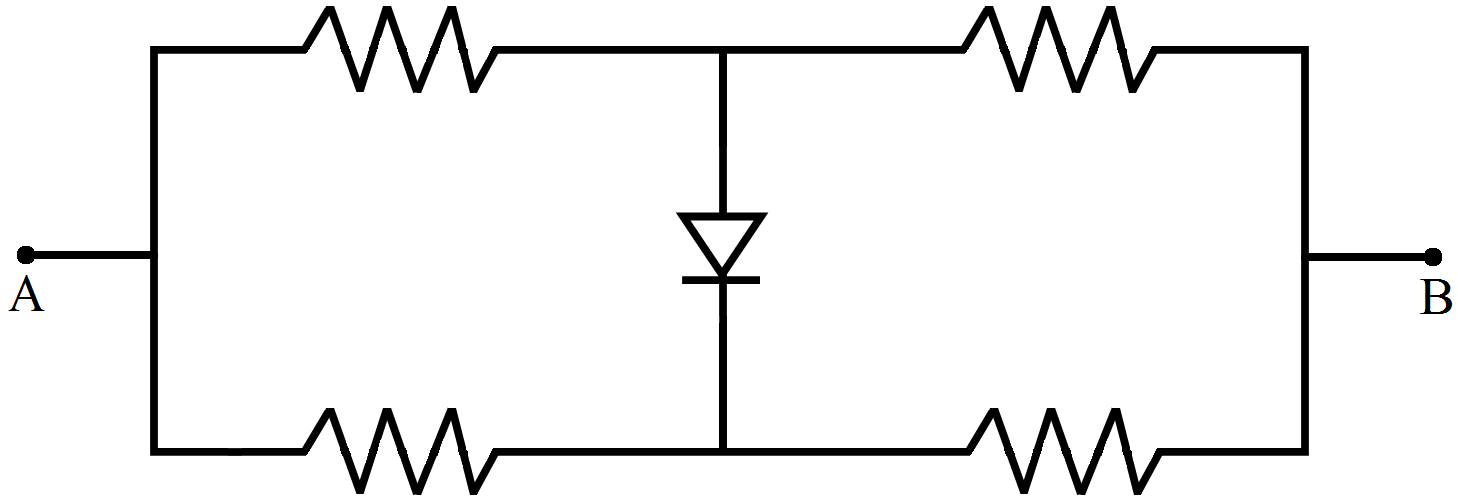
Each of the resistances shown in figure. has a value of $20\Omega.$ Find the equivalent resistance between A and B. Does it depend on whether the point A or B is at higher potential?

Why are cells combined ? Also, how can the combination of cells be done?