Question
Define Electric Flux. Write its SI unit.

Answer

Electric flux $\triangle\phi$, through an area element $\overrightarrow{\triangle S}$, is defined by
$\triangle\phi=\overrightarrow{E}.\overrightarrow{\triangle S}=E\triangle S\cos\theta$
where $\theta$ is the angle between$\overrightarrow{E}\text{ }\text{and}\text{ }\overrightarrow{\triangle S}.$
S.I unit of electric flux is $NC^{-1}m^2$.

Need a full question paper?

Generate a complete, print-ready paper with questions like this in minutes — across 16+ boards, with answer keys.
Start Generating Free

Similar questions

The threshold wavelength of a metal is $\lambda_0.$ Light of wavelength slightly less $\tan \lambda_0.$ is incident on an insulated plate made of this metal. It is found that photoelectrons are emitted for some time and after that the emission stops. Explain.
An air bubble is formed inside water. Does it act as a converging lens or a diverging lens?
Two wave pulses identical in shape but inverted with respect to each other are produced at the two ends of a stretched string. At an instant when the pulses reach the middle, the string becomes completely straight. What happens to the energy of the two pulses?
Can the peak voltage across the inductor be greater than the peak voltage of the source in an LCR circuit?
Which of the following is a semi-conductor?
(i) Copper
(ii) Gallium Arsenide
(iii) Sulphur.
Do you expect the gas in a cooking gas cylinder to obey the ideal gas equation?
When a body is weighed on an ordinary balance we demand that the arm should be horizontal if the weights on the two pans are equal. Suppose equal weights are put on the two pans, the arm is kept at an angle with the horizontal and released. Is the torque of the two weights about the middle point (point of support) zero? Is the total torque zero? If so, why does the arm rotate and finally become horizontal?
Consider a book lying on a table. The weight of the book and the normal force by the table on the book are equal in magnitude and opposite in direction. Is this an example of Newton's third law?
What is Electrodynamics?
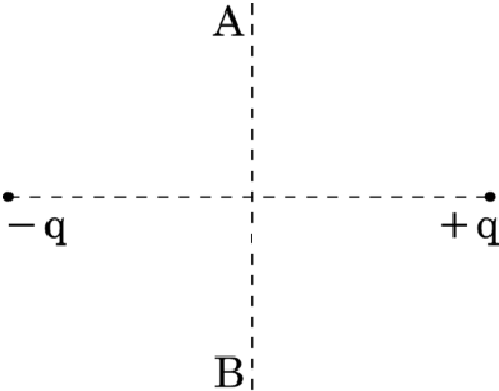
A charge 'q' is moved from a point A above a dipole of dipole moment 'p' to a point B below the dipole in equatorial plane without acceleration. Find the work done in the process.