Question
Define electric potential difference and prove that the electric potential at any point inside the electric field is equal to the ratio of the work W done in bringing a test charge from infinity to that point and the value of the test charge $q_0$.
Answer

SELF

Need a full question paper?

Generate a complete, print-ready paper with questions like this in minutes — across 16+ boards, with answer keys.

Start Generating Free

Similar questions

$i.$ An ac source generating a voltage $V = V _0 \sin \omega t$ is connected to a capacitor of capacitance $C$ . Find the expression of the current I flowing through it. Plot a graph of $V$ and $I$ versus $\omega t$ to show that the current is $\frac{\pi}{2}$ ahead of the voltage.
$ii.$ A resistor of $200 \Omega$ and a capacitor of $15 \mu F$ are connected in series to a $220 V, 50 \ Hz$ ac source. Calculate the current in the circuit and the rms voltage across the resistor and the capacitor. Why the algebraic sum of these voltages is more than the source voltage?
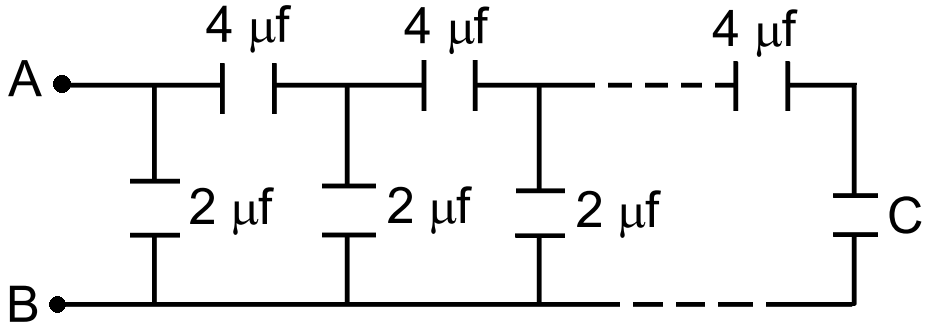
A finite ladder is constructed by connecting several sections of $2\mu\text{F},\ 4\mu\text{F}$ capacitor combinations as shown in figure. It is terminated by a capacitor of capacitance C. What value should be chosen for C, such that the equivalent capacitance of the ladder between the points A and B becomes independent of the number of sections in between?
Calculate the electric field in a copper wire of cross-sectional area $2.0mm^2$ carrying a current of 1A.
The resistivity of copper $=1.7\times10^{-8}\Omega\text{-m}.$
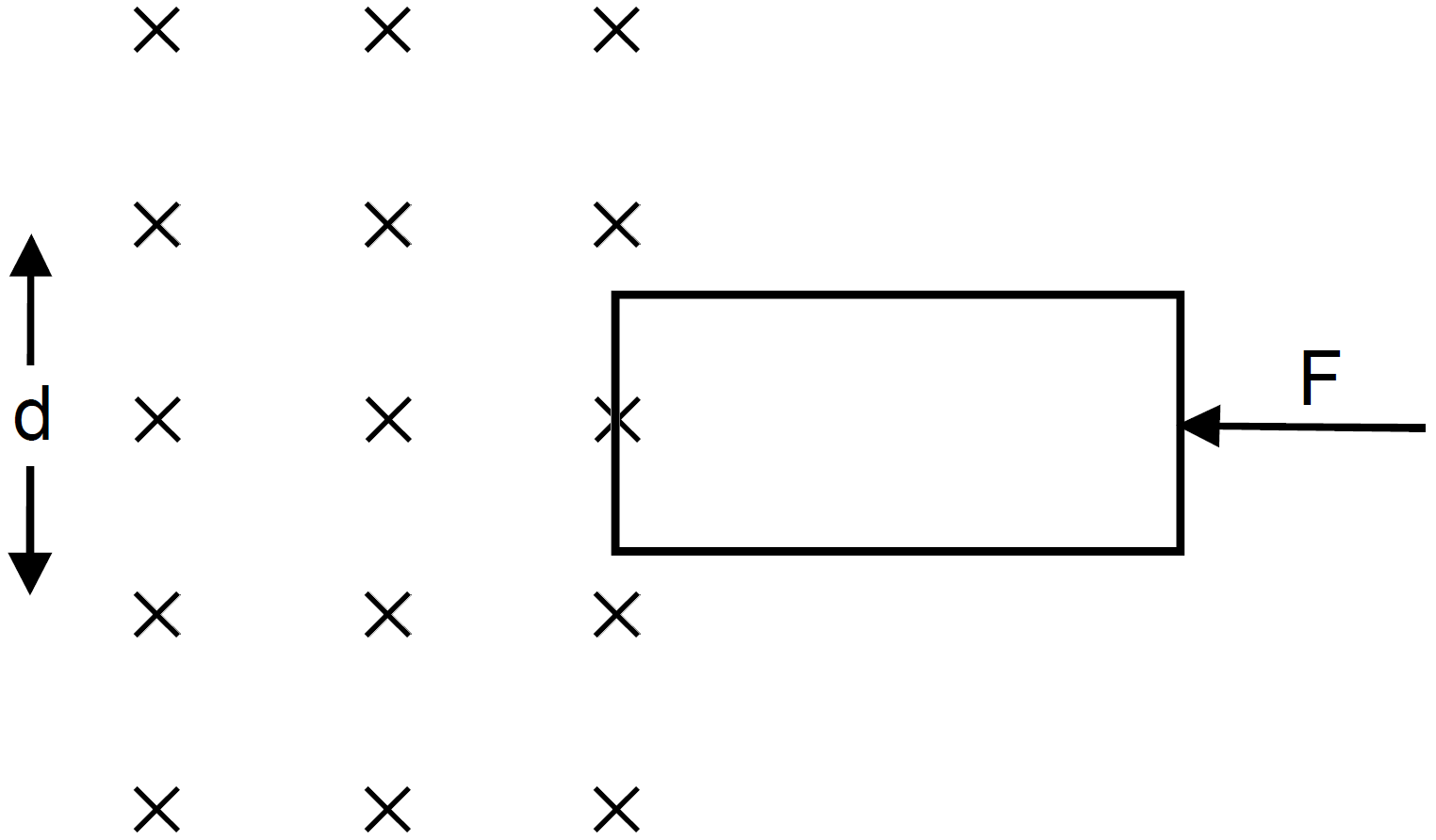
The rectangular wire-frame, shown in figure, has a width d, mass m, resistance R and a large length. A uniform magnetic field B exists to the left of the frame. A constant force F starts pushing the frame into the magnetic field at t = 0.
  1. Find the acceleration of the frame when its speed has increased to v.
  2. Show that after some time the frame will move with a constant velocity till the whole frame enters into the magnetic field. Find this velocity $v_0.$
  3. Show that the velocity at time t is given by $\text{v}=\text{v}_0\Big(1-\text{e}^{-\frac{\text{ft}}{\text{mv}_0}}\Big)$
In an experiment on photoelectric effect, the stopping potential is measured for monochromatic light beams corresponding to different wavelengths. The data collected are 11s follows:
wavelength (nm) 350 400 450 500 550
stopping potential(V): 1.45 1.00 0.66 0.38 0.16
Plot the stopping potential against inverse of wavelength $\big(\frac{1}{\lambda}\big) $ on a graph paper and find
  1. The Planck constant,
  2. The work function of the emitter and.
  3. The threshold wavelength.
A circuit containing a $80 mH$ inductor and a $60 \mu F$ capacitor in series is connected to a $230 V, 50 Hz$ supply. The resistance of the circuit is negligible.
$a$. Obtain the current amplitude and rms values.
$b.$ Obtain the rms values of potential drops across each element.
$c$. What is the average power transferred to the inductor?
$d. $ What is the average power transferred to the capacitor?
$e$. What is the total average power absorbed by the circuit? $[$‘Average’ implies ‘averaged over one cycle’.$]$
The count rate of nuclear radiation coming from a radiation coming from a radioactive sample containing $^{128}I$ varies with time as follows.
Time t(minute): 0 25 50 75 100
Ctount rate $R(10^9s^{-1}):$ 30 16 8.0 3.8 2.0
  1. Plot In $\Big(\frac{\text{R}_0}{\text{R}}\Big)$ against t.
  2. From the slope of the best straight line through the points, find the decay constant $\lambda.$
  3. Calculate the half-life $\text{t}_{\frac{1}{2}}.$
  1. Using the Bohr’s model calculate the speed of the electron in a hydrogen atom in the n = 1, 2, and 3 levels.
  2. Calculate the orbital period in each of these levels.
How would you set up a circuit to obtain NOT gate using a transistor?
A block of mass 200g is suspended through a vertical spring. The spring is stretched by 1.0cm when the block is in equilibrium. A particle of mass 120g is dropped on the block from a height of 45cm. The particle sticks to the block after the impact. Find the maximum extension of the spring. Take $g = 10m/s^2.$​​​​​​​