Question
Define fixed exchange rate. How is the exchange rate determined in a flexible exchange rate system?
Answer

Fixed exchange rate (also known as pegged exchange rate) is determined by the government and government has complete control over it. Under a fixed exchange rate, the exchange rate remains fixed as determined by the government.
Equilibrium Exchange Rate:
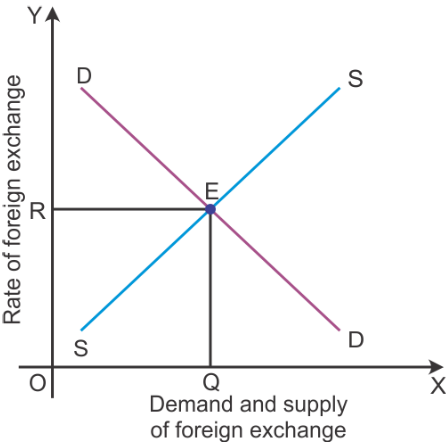
Under a flexible exchange rate regime, the exchange rate is determined by the forces of demand and supply. Demand for foreign exchange arises from the need to make payments in foreign exchange. Demand for foreign exchange varies inversely with the foreign exchange rate. As the foreign exchange rate rises, the demand for foreign exchange falls and vice versa. Supply of foreign exchange arises from the receipts of foreign exchange.
The supply of foreign exchange rate varies directly with the foreign exchange rate. As foreign exchange rate rises, the supply of foreign exchange rises and vice versa.
Equilibrium exchange rate is determined at the point where the demand for foreign exchange is equal to the supply of foreign exchange. Graphically, it is determined at the point where the demand curve for foreign exchange intersects the supply curve of foreign exchange.
According to the graph, the equilibrium is determined at Point E, where the demand curve DD intersects the supply curve SS. Here, the equilibrium exchange rate is OR and the equilibrium quantity of foreign exchange is OQ.

Need a full question paper?

Generate a complete, print-ready paper with questions like this in minutes — across 16+ boards, with answer keys.

Start Generating Free

Similar questions

When the price of a good X is ₹ 5, the consumer buys 100 units of the good X. At what price would he be willing to purchase 140 units of good X? The price elasticity of demand for good X is 2.
Define Credit Multiplier. What role does it play in determining the credit creation power of the banking system? Use a numerical illustration to explain.
What are revenue receipts? Explain the role of government budget in bringing stability in the economy.
Calculate ‘National Income’ and ‘Net National Disposable Income’ from the following:
 
 
(₹ in  Arab)
(i)
Net change in stocks
50
(ii)
Government final consumption expenditure
100
(iii)
Net current transfers to abroad
30
(iv)
Gross domestic fixed capital formation
200
(v)
Private final consumption expenditure
500
(vi)
Net imports
40
(vii)
Depreciation
70
(viii)
Net factor income to abroad
(-)10
(ix)
Net indirect tax
120
(x)
Net capital transfers to abroad
25
Complete the following table:
Output (Units)
ATC (₹)
AVC (₹)
MC (₹)
1
54
30
30
2
-
24
-
3
-
-
24
4
33
-
-
Suppose that a firm's TFC is * 100 and MC schedule of the firm is the following:
Output (Units)
1
2
3
4
5
6
7
MC (₹)
10
20
30
40
50
60
70
  1. Is the MC curve U-shaped?
  2. Derive AVC schedule. Will the AVC curve be U-shaped? Discuss why or why not?
How will you treat the following while estimating domestic product of a country? Give reasons for your answer:
  1. Profits earned by branches of country’s bank in other countries.
  2. Gifts given by an employer to his employees on independence day.
  3. Purchase of goods by foreign tourists.
How is tax revenue different from administrative revenue?
State and discuss four characteristics of perfect competition.
A consumer spends ₹ 80 on a commodity when price is ₹ 1 per unit. If the price increases by ₹ 1, what would be his expenditure. PED = -0.4?